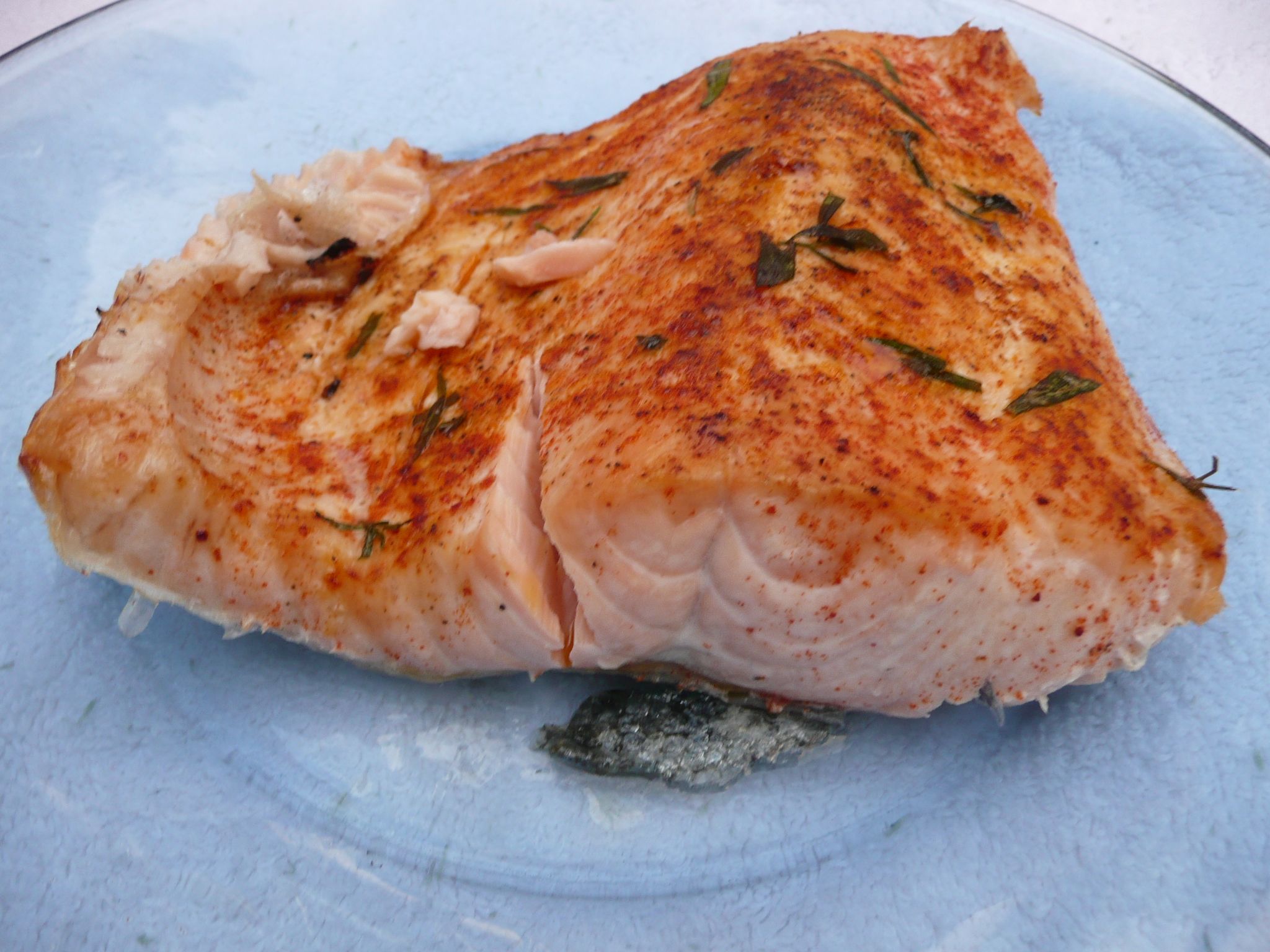
Salmon: Does food get much better? Salmon is fatty, full of vitamins and omega-3s, flavorful. It’s local and traditional in the Northwest. It’s fast and easy to cook.
And yet there are so many ways salmon can go wrong. There’s farmed salmon, whose failings have been detailed plenty of other places. There’s old salmon, tragically not eaten while it was fresh. And then there’s overcooked salmon, a chewy, dry reminder of what it could have been. Breaks my fish-fond heart.
I credit my perfectionist-scientist mother with my salmon-cooking skills. We spent summers in Seattle when I was a kid, where my mother, standing at the little Habachi grill (which I think was $5 at Pay ‘n’ Save?), or at the oven set to broil, produced perfect salmon with the same meticulous attention she applies to research. Flaky, flavorful, moist. We ate it with Northwest vegetables, homemade tomato sauce, blackberry pie, leaving permanent Northwest flavor imprints in my memory. The salmon even converted salmon-haters like my friend Ellie, who had never liked salmon until my mother made it for her the night Ellie and I met, when she was ten.
The secrets lie in selecting the salmon carefully, and serving it very slightly underdone.
.
Selecting Salmon
~ Choose salmon that is very fresh. Ask when it was caught. It should look firm and bright, not dull. It shouldn’t smell funny. Buy from a reliable vendor. I love the fish from Wilson Fish at the Ballard, Wallingford and Madrona farmers markets, and Loki’s stuff is also good. There are great vendors down at Pike Place. I’ve had some luck at Madison Market and at Mutual Fish on Rainier.
~ Choose belly fillets (the one that’s thick on one side and thin on the other) as opposed to tails. Belly has more fat and the thickness gives the fish better consistency. King is the fattiest and best, but is also expensive. Go for as thick and high-fat as you can find/afford.
~ Look for nice, pronounced fat lines
~ Buy wild salmon
~ Fresh is better than frozen. Fresh has better consistency. Frozen is okay if you can’t get fresh.
~ Alaska, BC and Washington have more sustainable salmon fisheries than other locations
.
How to Cook Salmon (but NOT overcook salmon)
Salmon on a grill is still the best. If you’re doing that, follow the directions below for doneness and seasonings. Cook it face-down first, so the fat from the skin soaks into the meat. Then, flip and let it cook until it’s done, while letting the skin get a bit grilled for added deliciousness. Get one of those cage-like fish-flipping devices; it’s a good investment to make this process easier.
This recipe is for salmon in your oven set to broil. It’s easy and comes out great.
- 1 fillet of salmon, preferably belly.
- olive oil
- optional toppings (not too much): lemon juice, olive oil, black pepper, smoked paprika, fresh tarragon, fresh garlic sliced thinly
1. Set broiler to high and position rack right under the flame at the top of the oven.
2. Line a baking dish or oven-proof skillet with aluminum foil. (You can skip the foil if you don’t mind serious scrubbing). Place salmon on the foil. It’s okay if the thinner side is a little folded, so it doesn’t dry out. This helps you get away with using a slightly-too-small pan, too.
(ADDED NOTE: You can place the salmon one of two ways: 1. You can use my original recipe here, which cooks the salmon cut side up the whole way. 2. Alternatively, you can start with the skin side up to crisp the skin for maybe two minutes and then flip the fish after two minutes. I recommend starting with the simple way and then experimenting with the other one if you like the original recipe.)
3. Drizzle with olive oil. Add on bits of other toppings if you like. You don’t need much, because salmon is so flavorful on its own, but a bit of smoked paprika can be nice, as are any of the flavors listed above. If using herbs like tarragon, press them down into the oil coating the fish.

4. Set under the broiler. Check frequently. Estimates vary between 7-10 minutes per inch of thickness, but I prefer to watch it.
Here’s how to tell it’s done:
~ The top is slightly brown and/or tiny bits sticking up get a little charred
~ A little whiteness appears at the sides from the fat
~ When a wooden spoon pressed on top gives back a little resistance but not too much
~ And the MOST IMPORTANT: cut into the thickest part. At the bottom, you should have some translucent, raw-looking fish. BUT! This fish is easily parted with a butter knife. If there’s raw-looking salmon that can’t be teased apart with a butter knife, it needs another moment. If it can, DO NOT cook the salmon any longer! The fish is moistest and most delicious when you leave this translucent area as so.
Photo evidence: This salmon is perfectly done! That translucency is your friend!

Serve salmon simply with a side of steamed vegetables and butter, or with some vehicle for homemade tomato sauce, or whatever you like with salmon. Remember also that the skin is delicious and full of nutrients. If it’s too chewy for you, fry or broil it on its own a bit until crispier.


 Seattle Local Food

It’s also fabulous baked in the oven on a rack over another rack that has a shallow pan of water on it. This way it gets baked and steamed and stays super moist! I’m so glad I have some in the fridge or I’d have to run out for it right now!
agreed carbzilla– the OP missed the boat on this one. broiling salmon results in the top layers being way overcooked, and the middle being rare. mind you i do like it on the rare side but not encased with dry, overcooked salmon. key is baking it on low heat on the middle rack, skin side down, with a tray of water underneath.
i marinate with a little bit of oil and on top- mustard, minced garlic, dill, chopped onion, capers. a little bit of protection from the heat above. bake for 22 to 25 min depending on thickness. careful taking it out– it’ll be so tender and flaky, pieces may drop into the water below.
squeeze a little lemon on it and enjoy.
^ they must be doin’ it wrong! I broil my salmon every time and it’s always perfect. 5-7 mins is all it takes and it’s never raw, translucent, dry or uncooked in any way. In fact, we’re having sweet & smokey rubbed salmon tonight. It’s always extremely moist and flaky. Baking it, in my opinion, is the worst unless your oven temp is around 350 and you foil-wrap. Still.. Broiling is by far our favorite way to cook salmon.
what temperature do you bake the salmon?
I put it in the broiler setting on high and put it up near the broiler.
[…] September 23, 2010 by seattlelocalfood We’ve covered a few different ways to preserve or cook salmon, like making gravlax and broiling fresh salmon. […]
[…] (Here are my tips on how to cook salmon perfectly.) […]
[…] (Here are my tips on how to cook salmon perfectly.) […]
[…] take it off the grill, and you have to account for that. Seattle Local Food has a detailed post on how to cook salmon perfectly: other than that, my best tip is to watch it carefully and don’t be afraid to pick it apart […]
[…] I’ve also found some wonderful tips on cooking salmon and picking out a good cut on this site. Overall, aim for pieces that come from the belly, not the tail, and cook for 7 to 10 minutes per […]
[…] for 15 to 20 minutes. Cut into center of largest filet to be sure that it flakes easily and is just slightly translucent, but try not to over-cook. Serve with grilled vegetables – asparagus is my […]
This technique worked perfectly. Thanks for posting this.
I really like to use my broiler for preparing fish. Gives a nice color and it takes no time at all…
WORKS! Fish was even a little old, but after this method, tasted fresh
YUM- using this tonight! thanks!
Your recipe was killer! Thanks for the recommended method. It was delish!
Omg… i just LOVE salmon. But I wish I had seen this article a month ago! I’ve been buying a big fillet each week, baking it and having it for breakfast, lunch or dinner throughout the week. Mostly have been shopping at the seafood market in my city (Wholey’s in Pittsburgh, PA). Not knowing what I was doing, the first week I bought the cheapest farm-raised. But it was still delicious. Then, when I went the next week, I decided to try the Scottish Salmon. I heard the man behind the counter telling someone it is farm raised but doesn’t have the antibiotics, etc. That tasted quite good also. But still, I was thinking I should really go with wild- caught. The next week I went to Whole Foods and got a Sockeye fillet, and then this past week, decided to ‘go for gold’ and bought a King Salmon fillet. Arrrggghh…I wish I had seen this article! I really didn’t like the Sockeye and have also been quite disappointed in the King… but I think that maybe I overcooked them! I saw that little bit of ‘undercooked’ flesh in the middle and popped it back into the 425 oven for another 8 minutes (directions I was using: melt coconut oil in baking pan, bake skin side up first for 7 minutes, then flip over and bake another 7 minutes). Now I’m pretty sure that I overcooked the Sockeye and the King [there’s my $100 lesson 😦 ]. I threw that overcooked fish in a ziplock bag in the freezer, and found this article as I am trying to find something to do with it, so it’s not a total loss. Any ideas? Thanks again!!
Such a great article. Your passion shows and inspires us. Also you’re right on target.
You need to proofread a couple items… did you mean position the rack right under the broiler on the BOTTOM of your oven? That will confuse people – you said top of oven. No one has a broiler on top.
Also at the end when you suggest ways to make the skin crisper – you’re missing the word SIDE.
THANKS FOR THE EXCELLENT CONTRIBUTION!
O. The girl I’m cooking for has a broiler on top. IN MY FACE. lol.
Hey Adam,
Thanks for your comments. Are you on the East Coast? I grew up in a NYC apartment with a separate broiler drawer on the bottom, and I didn’t know there was any other kind of oven until I left the East Coast. Now I live in Seattle, where ovens always just have a broiler setting on the top of the main oven, and you have to move the rack accordingly. It’s also possible this has absolutely nothing to do with location and is just an old style versus new style of oven question. I suppose I could Google it. 🙂
I’ll make the other edit. Thanks for the second pair of eyes! Enjoy your salmon!
Wow, whoever is saying this doesn’t work is TOTALLY wrong! This was an awesome direction of making Salmon. I have been banging my head on the wall to find a way to cook salmon perfectly. This did it! I put the pan on the TOP RACK like it said and put it in for 8 minutes exactly. BOOM! it was just right. I cant wait for the hubby to get home to taste it.
I followed all directions and dried it out and have a question regarding broiling.
If broiling with electric or gas, should the door to the oven or broiler be left partly open? the heat is right above so leaving the door open makes most sense. closing it may have dried it out. I have been reading salmon broiling for an hour and no one mentioned this in their instructions but it would effect cooking time and maybe dry it out?
Close the door to the broiler. How thick was your salmon fillet? This might be difficult with an unusually thin piece of salmon, unless you broil it very quickly.
Too bad that many recipe sites recommend 145 internal degrees for salmon. Ruined part of my fresh, just caught King Salmon. Lesson learned.