Feeds:
Posts
Comments

Christina Kim Choi

For those who haven’t heard, Seattle lost the incredibly kind and talented Christina Kim Choi, founder of Nettletown and co-founder of Foraged and Found. She was also a friendly face at the farmers market, an artist, a friend. I saw her not too long ago at the farmers market. The news still doesn’t feel quite real.

Here is the link to the blog her family kept during the days of treatment that followed her brain aneurysm earlier in December.

Here is the link to the Seattle Times article.

Thank you, Christina, for changing our Seattle world for the better in the time you had. You will be missed.

A few weeks ago, I tried an apple-fennel sauerkraut at a farmers market in Oakland. It was fresh and tasty, with whole fennel seeds mixed into the shredded cabbage and sliced apple. It inspired me to make my own, but to shape it according to my own taste.

I felt like the apple stood out too much in the kraut from the market. The pieces were big, cut differently from the green cabbage. Also, while the fennel seed was nice, I wanted to see what the recipe would taste like with slices of fennel bulb fermented along with the other ingredients. And while fennel seeds are tasty, I’ve been wanting to put caraway seeds in my sauerkraut for a while. I have a slight addiction to caraway seeds, the kind that happens when you grow up in New York thinking that the term “rye bread” is always preceded by the term “heavily-seeded,” if you want the good stuff.

Hence, this recipe. It’s worked out well. It’s been fermenting for a week and a half now, almost two weeks, and getting better every day. Try it out, and make your own variations. Enjoy!

Apple-Fennel Sauerkraut with Caraway Seeds

  • 1 small-med head green cabbage
  • 1 small-med onion, sweet or otherwise
  • 1 tart apple
  • 1 medium head of fennel (or more, if you like)
  • 1-3 Tablespoons caraway seeds
  • 3-5ish Tablespoons kosher salt
  • filtered water (Brita or store-bought). The water must be filtered, because chlorine can interfere with the fermentation process.
  • 1 ceramic crock, pretty easy to find at Goodwill
  • 1 plate that just fits down into said crock
  • 1 big jar or glass
  • a piece of cheesecloth or a big, thin cloth


1. Chop up green cabbage into very fine pieces, removing any of the white core part. Chop up onion or sweet onion into thin strips. Chop apple into thin strips mirroring the size of the cabbage and onion strips. Chop the fennel into thin strips, discarding the core and using only a little of the green part if it’s tender. Set aside a handful of caraway seeds, some kosher salt, and some filtered water.

2. Put the cabbage shreds in the crock first. Take a few tablespoon-sized pinches of kosher salt. Mix it into the cabbage, coating the pieces. Press down on the cabbage as you do this, to encourage the cabbage to start sweating. Then mix in the other vegetables and as much of the caraway seeds as you want to use (the favor goes pretty far).

3. Now, some people never add any water to their sauerkraut, because they magically get the cabbage to sweat enough liquid to cover the whole thing, which is the goal; you don’t want air touching the vegetables. But I’ve found at least some filtered water is necessary. Still, I give it a little time before I add the water, maybe a few hours.

4. To compress the kraut and help it sweat, take that small plate that fits inside your crock and put it on top of the cabbage mixture, pressing down. To hold it down, take that big jar and fill it with water to make it heavy. You can put a lid on in case it spills. Then drape your cheesecloth over the whole thing to keep bugs out.

5. Check it after a few hours. If the cabbage hasn’t released enough liquid to cover the mixture fully, go ahead and add some filtered water until it is covered.

6. The next morning, taste the water. Does it taste at all briney or does it just taste like water? If it just tastes like water, go ahead and toss in some more kosher salt.

7. Check the kraut every day. If a little white mold grows toward the top (I find this is less an issue with kraut than it is with pickles), skim that off.

8. The kraut should start being good after five days, get really good after a week, and get excellent in the 1.5-2.5 week range. Wherever you like it, at whatever stage of fermentation, put it in the refrigerator to slow down fermentation.

Enjoy!


My mother’s turkey recipe

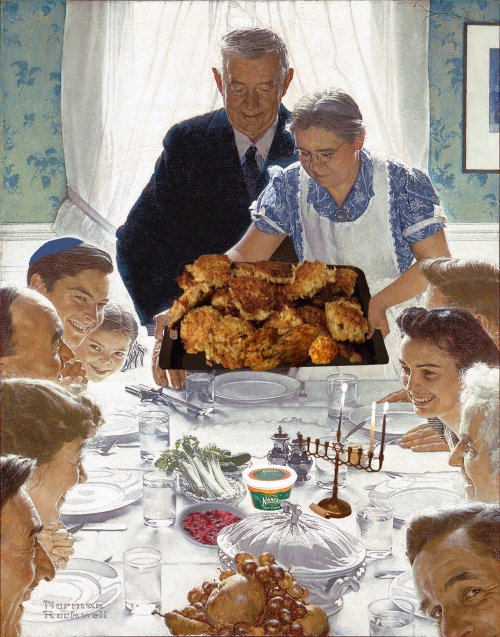
Picture is my mother’s turkey last year. It’s a very small one, and she uses fewer vegetables than I do.

~

I haven’t posted in a while, but I was just writing out the family turkey recipe for someone and thought I’d share it with you all too. If you’re looking for a delicious recipe that keeps the turkey moist and uses a lot of local vegetables, this is a great one. Down below the recipe, you’ll find some options for stuffing and a fairly ridiculous story related to this turkey recipe.

Happy Thanksgiving!

My mother’s turkey recipe

Scientifically proven to convert vegetarians (n=1)

This recipe is for a large turkey. Use a bit fewer vegetables for a smaller bird.

Ingredients:

  • Carrots — Probably two or three bunches for your size bird, depending on how big a roasting pan you have
  • Celery — At least a full head
  • Onion — Two or three, again depending on the size of your pan and the number of Jews (or Italians or other alliumphiles) present
  • Mushrooms — A big paper bag full? More? I love mushrooms; I’d say, buy a ridiculous number of mushrooms, realize you’ve bought too many for turkey, and use the rest in the traditional post-Thanksgiving omelet
  • Optional vegetables — Fennel and leeks are particularly nice. Potatoes are good too, although the starch will thicken the sauce a little. Some people like that, but I prefer it liquidy.
  • Tarragon — a sizable bunch/handful, leaves pulled off stem
  • Sage — a few good-sized sprigs, chopped small
  • Thyme — optional, but I like it. A few good-sized sprigs, pulled off stem
  • Turkey — usually helpful for a turkey recipe
  • Olive oil
  • Butter — optional if it’s too treif
  • Lemons — one or two
  • Kosher salt
  • Wine — red or white or a mixture, for the sauce
  • Cheesecloth
  • Tongs for the cheesecloth (or tough hands)
  • Cooking twine and a needle (or mad tying skillz)
  • A big roasting pan
  • Rice for the side — I like making both wild rice and regular white/brown rice. I cook my wild rice with sautéed onions and broth.
  • Stuffing — See options below or make your own. 

1. Prep:

Prepare your stuffing (see below).

Preheat oven to 450F.

Prepare your bird: My mother washes it, but I don’t; the thing is going to be roasting in a hot oven for a few eons, and washing it means you then have to wash your sink. Check for pin feathers and remove any. Take some tarragon leaves and some thin squares of butter, if you’re using it, and slide them under the skin of the whole bird. To do this, lift the skin gently at the turkey’s opening and coax the butter and tarragon up and over the breast and thighs. If you aren’t using butter, coax the tarragon up anyway and try to get a little olive oil but over and under the skin. Drizzle lemon juice all over the bird and in the cavity. You can even slice a bit of the lemon rind and tuck it under the skin, although that really changes the flavor.

Then fill the bird with stuffing and tie it closed, using cooking twine and a needle to sew the cavity closed or just get creative wrapping the thing with twine. I recommend sewing closed if you can. Finally, coat the bird with olive oil, rub it in, and sprinkle with salt. Dampen your cheesecloth with water and then coat it with olive oil, and drape the bird with cheesecloth.

2. Roasting:

The turkey starts at 450 degrees for the first half hour, then is lowered to 375 for the remainder of cooking time, which is 15 minutes per pound (add a little more if it’s a stuffed bird). The turkey should roast on its side, one wing up at a time. For the first hour (450 for 30 minutes, 375 for 30 min), you want to rotate every 15 minutes. After that, rotate every half hour. When you rotate, make sure the cheesecloth is keeping it moist; readjust the cheese cloth and pour on more olive oil as needed. If there are drippings, you can spoon those back up over the turkey to baste it when you rotate; this will get easier during the vegetable portion.

3. Vegetables other than mushrooms: 

When I make this recipe with a chicken, it rests on vegetables the whole time. With a turkey, it rests on vegetables only the last hour and a half. So, calculate when that will be, and start chopping your vegetables within the hour before predicted veg time. You want your vegetables sliced thin. This is one of those few recipes where the vegetables should end up soft in the sauce so they’ve absorbed as much turkey and wine flavor as possible, and the sauce is, well, sauce-like. So, cut very thin carrot and celery sticks about 3-4 inches long, thin strips of onion, and thin strips of fennel and leek if you’re using them. Do not use the mushrooms yet.

At t-minus* 1.75 hours, start pre-cooking your vegetables in olive oil in a heavy pot on the stove, with all of the sage and about half the tarragon. Add salt.

At t-minus 1.5 hours, take the bird out of the oven, lift it from the roasting pan, and make a bed for it out of all the vegetables, stirring them well into whatever drippings are down there. If whatever’s down there is browned onto the pan, use a dash of wine to deglaze it, and coat the vegetables with that. Place the turkey back on the vegetables, with all the wing-up rotations and oily-cheeseclth-testing done, and continue roasting, rotating every half hour. These times, stir the vegetables every time you rotate the bird wing-to-wing.

*Rumor has it that the phrase “t-minus” comes originally from the amount of time left until a turkey is done roasting. While this rumor has yet to be verified by any kind of trustworthy source like, er, the Internet, I think I’ll just go ahead and start telling all my friends this.

4. Mushrooms: 

Slice the mushrooms thin in time for t-minus 30 minutes. If you’re using some wild mushrooms, cut them in larger chunks.

Stir them into the other vegetables and place the turkey breast up for the last half hour of roasting. The theory here is that by placing it wing/leg up for most of the time, you’re getting the fat from those meats dripping down into the breast and keeping it moist/preventing it from drying out, but for the last half hour, now that it’s been nicely saturated, you want to get that skin nice and brown. This is a good time to start cooking your rice too.

5. Finishing:

Make sure the turkey is done by stabbing a thick joint between the leg and body to check if the juices run clear. The whole turkey should be golden brown. Put some fresh tarragon on it. Let the turkey rest 10-15 minutes at least before carving. Most people wait longer, given the arrival of guests and frantic finishing of other dishes.

But do take it out of the vegetables right away, because you want to make those into your sauce. To do so, pour wine directly into the vegetables. You can use white or red or a mixture. I prefer white for chicken, and a mixture of white and red for turkey. Red is good in this sauce, but it becomes a little strong with just red. I never measure the wine, honestly, I just keep tasting it until it tastes like my mother’s. But I’m guessing for turkey, and for this quantity of vegetables, it would be at least a few cups. Also, stir in all your remaining fresh tarragon leaves. This sauce is delicious on rice or mashed potatoes or just eaten by the spoonful.

Stuffing options

My mother just chops tiny pieces of onion, carrot, and celery, and sautés them with tarragon and sage and chopped Italian parsley, then uses that as a stuffing.

I start with that idea, but I add to it: some cooked brown rice and/or wild rice, maybe some gluten-free croutons (which someone was selling at the U-District market last Saturday), a handful of cranberries. Do whatever you like, but the sautéed onions, tarragon, and parsley should definitely be included. Stuffing isn’t a thing of measurements; just mix up whatever looks good to you.

Story time

The story gets saved for last. It’s a bit awkward, since it deals with my mother’s slight discomfort at the time with lesbians getting pregnant and having children — my mother is now very open-minded — but it’s hilarious and worth sharing, if you’re into awkward food stories about reproduction and mothers getting over their homophobia.

So, about ten years ago, my college best friend was ready to have a child (now my nearly-nine-year-old wonderful nephew). She had her child through a donor. This involved long, complicated processes of finding a good company in California, choosing a donor, and receiving a delivery kept cold on dry ice to rural Michigan, where she lived. (Not that there is any shortage of cold already in Michigan in the winter.) It also involved careful instructions for helping increase the odds of fertilization — not just the obvious things about timing around ovulation, but directions on what position to lie in afterwards and such.

That’s the thing: the old myth of instructions to use a turkey baster is false, but there are some other parallels with turkey. Specifically, as my friend described to me, she was instructed to spend several hours lying still, rotating from side to side. Fifteen minutes on each side, and then rotate every half hour or so, one hip up and then another. Then lie face up for a little bit.

“Uh, that’s my mom’s turkey recipe,” I told her. “Are you sure you didn’t mix up the instructions with the turkey recipe? Did I give you her turkey recipe maybe? Did I accidentally print it on stationary from a clinic I’ve never visited in California?”

“I’m sure I didn’t mix it up,” she promised. “I don’t have your turkey recipe. I’m a vegetarian.”

Meanwhile, I had been slowly working on my mother to get over any remaining homophobia in her system. My mother never harbored any hatred, just the discomfort of generational unfamiliarity, enhanced a bit by a childhood surrounded by musical theatre and film that prioritized heterosexual relationships above all. My mother had crushes on Marlon Brando and Sandy Koufax and Ezio Pinza. The idea of women partnering with women was still foreign to her. She graduated from an all-women’s college in the early 60s, but it was not an era in which many women were coming out. (“I remember there was one lesbian couple,” she once told me. “They sold cigarettes.”)

So I called up my mother. “I have to tell you a story,” I said. “I know you’re a little weirded out by the whole way D is getting pregnant, and that’s unfamiliar to you. But I think you’ll appreciate this if you can get past the discomfort.” I told her about the directions. “What does that sound like?” I asked her.

My mother paused. “That’s my turkey recipe,” she said, faintly. And laughed.

Fast forward nine months. I flew out to Michigan to be a birth partner to my friend, along with another dear friend of ours. It would be us and three (count ‘em, three) midwives supporting a home birth in her house in the woods. I flew out a few weeks early, just in case. Besides, at eight and a half months pregnant, my friend was in charge of a Thanksgiving dinner for several dozen people. I didn’t want to worry about her getting exhausted hauling giant pots all over the kitchen, and promised to take on the turkey and as much of the rest of the cooking as she wanted.

Of course, I brought my mother’s turkey recipe.

The Thanksgiving went off smoothly, and she even forgave me for being neurotic about the cutting of carrots (she was cutting large chunks, because she wanted them to be hard). After smelling the turkey cooking all day, and with the rather-increased appetite of being close to full term with a pregnancy, my dear vegetarian friend caved and devoured turkey. And ate it for leftovers. For days.

Today, I consider her son my nephew, and he is one of my favorite people in the world. He’s turning nine a week and a half after Thanksgiving. My mother is past her homophobia; she calls me up and rants about Republicans and their weird ideas about controlling marriage. My friend isn’t remotely vegetarian, and she makes my mother’s turkey recipe when she makes turkey, although she still cuts the carrots too big. She’s also an amazing mother, and lives much closer to me now.

And every Thanksgiving, I’m grateful for all of them, and for a good story.

Happy Thanksgiving!
FOOD DAY is here! Food Day local calendar is here!

After months of hard work, Food Day is upon us. Food Day events in Washington State have already started, and there are some amazing things coming up this weekend and next week. Seriously, a field trip to the fascinating urban ag model at Hilltop Urban Gardens in Tacoma, a tour of the new Seattle Tilth farm in Auburn, the wonderful Eat Local Now! dinner in Seattle, a workshop on the Farm Bill in Seattle, a Seattle Farm Co-op launch party in Seattle, Nourish food + community film screenings all over Klickitat County, a day of events at WSU, a symposium at UW, an event about ending hunger in Skagit County, a feast and educational event in Clark County, screenings of The Greenhorns with the director in attendance… and SO. MUCH. MORE.

I’m excited. And getting hungry. (No, seriously. I’ve been working on Food Day since I woke up and forgot to eat. Ironic, right?)

Okay, details: There’s a wordpress calendar of WA activities here. PLEASE share this calendar on with others. These events are amazing and you should check them out, along with a few hundred of your closest friends.

A bit about the flagship dinner for the area, the Eat Local Now! event. Here is the press release for the event. If you’ve never been to Eat Local Now! and can afford to go, please do. It’s one of my favorite events of the year. I’m actually flying in for it straight from Food Day events in San Francisco, just to make sure I don’t miss it.

Eat Local Now!
Monday, October 24, 2011, 6-9:30pm.
at Herban Feast SODO Park

About the event and the organizations running it:

The 8th Annual Eat Local Now! Dinner Celebration encourages participation in local food systems, bolstering food equality for all. The event is at Herban Feast in Sodo Park at 3200 1st Avenue South in Seattle on October 24. Get tickets and more information for the 8th Annual Eat Local Now! dinner at EatLocalNow.org or by calling 1-800-838-3006. This year’s event presented by Sustainable West Seattle, CoolMom.org, Herban Feast and The Seattle Good Business Network.

CoolMom.org unites families to affect climate change through education, lifestyle change, and advocacy. CoolMom’s vision is to inspire moms, families and communities to practice sustainable living in how they live, learn, work and play to build a better future for our children.

Herban Feast is continually finding new ways to use regional suppliers, assist the area economy and agriculture community by sourcing ingredients from local producers and farmers, and employing sustainable practices. Herban Feast provides off-site catering at venues throughout the Puget Sound region and on-site catering at our distinctive event venue, Sodo Park. You can also find us at our farm-fresh, full-service restaurant, Fresh Bistro in West Seattle.

Seattle Good Business Network (formerly BALLE Seattle) is a non-profit venture that connects, empowers, and promotes Seattle-area business owners who care about the future of our place. Members are locally owned, independently operated businesses of all kinds.

Sustainable West Seattle educates and advocates for urban sustainability in our local community. SWS envisions a West Seattle community of empowered citizens who actively lead toward greater self-reliance, local democracy, social justice, and existence in harmony with life on earth. SWS meets the 3rd Monday each month at 7 PM.

Event contact: Christina Hahs
info (at) eatlocalnow.org
206.307.4860

Media contact: Kate Kaemerle
katekaemerle (at) gmail.com
206.743.4468

I’ve been busy getting ready for Food Day, hence neglecting the poor blog lately. I’ve ended up the West Coast Coordinator of Food Day, focusing primarily on the Bay Area and other parts of California, as well as Washington State. I haven’t had much time for many of my favorite autumn activities like mushroom hunting, but I did take a few hours after services on Rosh Hashanah to head out into the woods with a friend and find some delicious chanterelles.

They were so fresh, and I was somewhat disciplined, so I still had some left and in good condition by the day I was preparing for my meal before the Yom Kippur fast. I wanted to eat something that would be filling but very digestible, and definitely delicious.

I settled on something coconut-milk-based, for its long-satiating fat and easy digestibility. I cooked chicken thighs with a little onion in coconut milk, added a little lemon juice and fish sauce, and served it with brown rice and cilantro. The meal was simple to prepare and even tastier than I expected, particularly because the flavor from the chicken cooked out into and mixed with the coconut milk sauce. Also, when the time came to break the fast on the next night, I wasn’t ravenous.

~

Chicken with Chanterelles, Coconut Milk, and Lemon

Serves two

  • chicken thighs and/or other parts (I made one thigh per person, but you may want more)
  • chanterelles or other mushrooms – about 1/2 pint or a generous handful
  • 1/2 can coconut milk
  • 1/2 small/medium onion
  • dash of fish sauce
  • black pepper
  • a few pinches of fresh cilantro
  • juice of 1/2 lemon
  • coconut oil


1. Cook rice separately if you’re making it.

2. In a heavy skillet, like a cast-iron skillet, heat coconut oil. Place chicken parts into hot oil and cook about a minute or two on each side to brown. When you turn them to the second side, add onions all around them and stir.

3. When onions are softening and turning clear and a little brown, add the chanterelles and a little more coconut oil. Let them cook for a minute or so, stirring to make all sides touch the pan.

4. Add most but not all of your half-can of coconut milk to the chicken. Add a dash or so of fish sauce. Cover the pan with a lid and turn the heat to medium. Let it cook for a while, probably in the 20 minute range, until the chicken is cooked all the way through and liquids run clear when you poke the thickest parts with a knife.

5. Taste the sauce and adjust for salt/fish sauce. Grate in some fresh black pepper. Turn off the heat and add lemon juice and remaining coconut milk.

6. Serve with or without brown rice, and with cilantro sprinkled on top.

I’m out of town today, which is a bit of a shame, because there are a number of great events going on in Seattle and Western Washington.

The most delicious-sounding in Seattle: Mobile Food Rodeo, Seattle’s new food truck event. Twenty-one food trucks of all sorts, from Skillet to Minimus Maximus.

Seattle is trying to catch up with other cities that have realized mobile food vending has a lot of potential to improve city life: it’s great for talented food entrepreneurs, and it’s great for residents who like to eat. It can even be a creative way to bring healthy food to neighborhoods, when cities provide incentives for food trucks meeting a certain healthy-food standard (e.g. produce vending trucks). Also, there’s something appealing about street food, eaten outside, often strongly-flavored. Calvin Trillin once described it as best eaten standing up, so one can jump up and down a little when it’s really delicious.

Please go to this event and eat something delicious for me. If you’re tweeting, it’s #mobilefoodrodeo

Also, if you want to get out of town for the day, our friends at Skagit River Ranch are hosting an awesome farm day festival. Skagit River Ranch is a wonderful farm. The owners, George and Eiko, devote themselves to producing high-quality pasture-raised meat and eggs. Their farm is in a lovely spot by the Skagit River. The day’s going to feature cooking demos, tours, a raffle, grilled meats, and even chicken poop bingo. Seriously.

Finally, head out to Port Townsend for the keynote evening of the Northwest Earth Institute’s Biannual Conference, to catch Will Allen’s talk on urban/community agriculture. From their email:

A keynote speaking event, co-sponsored by the Food Coop, The Good Food Revolution: The Power of Community Agriculture, with Will Allen – Milwaukee’s famed urban farmer   http://growingpower.org/assets/presskit.pdf

Hear Will Allen, son of a sharecropper, former professional basketball player and ex-corporate sales leader, one of the preeminent thinkers of our time on agriculture and food policy, speak on how he lives from his belief that all people, regardless of their economic circumstances, should have access to fresh, safe affordable, and nutritious foods.

Confession: I’ve been having an affair with pupusas. I adore them. This doesn’t mean I don’t also love other foods deeply; my monogamous tendencies don’t really cross over into my world of eating. But there’s something incredibly satisfying about this treat, a soft-yet-crispy Salvadoran snack of masa (corn flour) stuffed with cheese, vegetables, beans, etc. And I’ve been devouring them more often than is probably reasonable.

I’m still going to eat traditional pupusas sometimes, and may even sometimes make them traditionally, but a pile of corn flour isn’t exactly good for me, especially at the rate at which one might eat it when one is having a food affair with a food in which it weighs heavily. And I generally consider low-carbohydrate/low-grain diets much more optimal for health, especially when they’re full of fresh, local, sustainably-produced vegetables and meats and eggs and fats.

Hence, today’s experimental recipe: the grain-free pupusa. I used almond flour and finely-ground golden flax seeds, which I found whole in the bulk bin at Central Co-op. This recipe made three pupusas, and my roommate and I gobbled them up. They’re really good. They’re denser than a traditional pupusa, and the flavor of the flour is definitely different, but they’re interesting and crispy and delicious with hot sauce. We even tried a few bites with crème fraîche which, while not traditional, was pretty delicious. Traditional pupusas are also served with a mildly-spicy cabbage slaw.

Try these out and tell me what you think. Oh and, of course, you can vary up the filling however you like.

And for those of you who eat low-carb or paleo or just don’t want to eat a lot of corn, but feel left out when your hipster friends go pupusa-devouring, now you can invite them over to try some homemade ones. I’m not saying they replace traditional pupusas. But they’re definitely worthy of having another affair.

~

Grain-Free Pupusas with Zucchini, Onion, and Squash Blossom

yields three pupusas

  • 1 cup golden flax seeds, which you need to grind up. If you can find pre-ground meal, that’s probably fine too.
  • 1/2 cup almond meal
  • 1/2 cup water
  • pinch salt
  • 1 small onion
  • half a small zucchini or other vegetables
  • two squash blossoms
  • 1 small, hot chili pepper*
  • handful of cheese: queso fresco, monterey jack, mozzarella, or whatever you want to try. You can leave out the cheese if you don’t want it, of course.
  • fat of your choosing (I used chicken fat/schmaltz)

*a tip for cutting peppers without getting spicy oils on your fingers: hold it by the stem and use a good scissors to slice bits off it directly into the pan.

1. Grind up the golden flax seeds finely. You can probably use a coffee grinder. You can definitely used a grain mill. I used my food processor and ran it for 5-10 minutes until I had a fluffy flour.

2. Take 3/4 cup of the golden flax meal. Mix it with the almond meal, salt, and water. Mix by hand. The result should be very pliable and only a little sticky. Keep sprinkling in flax meal until you have the right consistency.

3. Let dough rest a few minutes. Meanwhile, prepare your filling. Slice cheese into small pieces if not using already-crumbled cheese. Chop all vegetables very small and sauté in a large cast-iron pan (you’ll be using it again for the pupusas) with a shake of salt until cooked through. Take it off the heat, pour it into a bowl, and mix with your cheese.

4. Go back to the dough. Divide it in thirds, with a few pinches left over. Each third should be about the size of an egg. Make one into a ball. With your thumbs, make a big crater in it. Fill this with cheese and vegetables, not over-full. Gently pull the sides over the crater until no cheese or vegetables come through, pinching off bits of the thicker dough parts if needed. Flatten into a filled disk. If you still have vegetables and cheese poking through, use a little of that extra bit of dough you left out from your three portions. Set this pupusa aside and repeat for the other two.

5. Heat more fat. When hot but not smoking, add the pupusas. Fry on each side until brown spots form. Serve immediately with deliciously spicy salsas, slaws, or whatever you like.

FACT: Bulbs of fennel in piles at the farmers markets are still young and tender, with mild flavor.

FACT: The first fully-ripe apricots of the season have appeared in markets.

FACT: Chicken salad is delicious.

FACT: Thyme makes chicken salad even more delicious.

This simple FACT salad (so-named for fennel, apricots, chicken, and thyme) was inspired by a pile of ripe apricots. Fruit is, of course, a nice addition to chicken salads and tuna salads and other branches of the protein-y salad family. I liked the idea of apricots with cold chicken, since it’s delicious to cook chicken with apricots or plums. But I felt like a chicken salad with apricots also needed some sort of fresh crunch. Hence, the fennel. Add a bit of thyme, ideally lemon thyme, and some homemade mayonnaise, and you’re done. The salad would also work great with plums or pluots.

~

FACT: Fennel-Apricot-Chicken-Thyme Salad

  • two chicken thighs, cooked any way you like. (I pre-roasted mine.)
  • two ripe apricots
  • half a small bulb of fennel, white part and a little bit of green stalks and leaves.
  • a few spoonfuls of homemade mayonnaise (bowl recipe and food processor recipe). I made my mayonnaise mustard-heavy this time, and used both apple cider vinegar and lemon juice in it. I used the kind of mustard that has seeds in it, although that’s not necessary.
  • a few sprigs of thyme, ideally lemon thyme

1. Cook the chicken thighs, or use leftover roast chicken. I roasted them at 450 with a few vegetables, some schmaltz, and a little white wine. Cool them.

2. Chop up chicken, apricots and fennel into small pieces. Remove leaves from thyme sprigs.

3. Mix everything up with spoonfuls of mayonnaise to taste.

I spotted some lovely yellow patty-pan squash at the Madrona Farmers Market on Friday. They were medium-sized ones, at least a few inches across. Usually I like tiny patty-pan squash –– I like to cut them in half or quarters and quick-sauté them –– but I wanted to try doing something new. And that something was grilled cheese. Or… at least something grilled-cheese-like.

I cut off the tips and sliced each squash into four slices, two larger inside slices and two smaller outside slices. I pre-sautéed them with garlic, roasted them in the oven, spread them with tomato spread, filled them with cheese, and fried them again. Yum.

A warning for devotees of grilled cheese: This recipe doesn’t have the crispiness of a grilled cheese sandwich. It’s something else entirely, a pile of two-bite or three-bite snacks that are a little soft inside, but the softness works with the melty cheese and subtle flavor of summer squash. At a dinner of sandwich-like foods, these got finished before the regular grilled cheese.

~

Patty-Pan Squash Grilled Cheese

  • Patty-pan squash, about 3-4″ across, one or two squash per person
  • Butter
  • Garlic
  • Salt
  • Melty cheese, like monterey jack

Optional flavors:

  • pesto
  • tomato spread (ratio: 2 T tomato sauce; 1 t olive oil, pinch of salt, a few finely-chopped leaves of basil, a little crushed garlic)

1. Preheat oven to 375. The plan is to sauté the squash and then roast them, but you can actually grill them instead if you prefer, and they’ll be drier.

2. Carefully slice just the other bits of the top and bottom of the squash off; you want enough left that you can make four slices.

3. Slice the squash into four disks, two larger and two smaller. Chop up some garlic.

4. In a skillet, sauté the garlic and squash slices in butter until brown, using a little salt. The garlic is purely for flavor. You can add it into the cheese later if you like. I just snacked on mine; I can’t resist browned garlic.

5. Roast the squash slices for fifteen minutes or so. If you want to help some moisture evaporate, you can put them on a cookie-cooling rack over a baking sheet, but this isn’t necessary.

6. Slice cheese. Prepare pesto or tomato mixture if you like.

7. Take squash slices out of the oven. Match them according to size. Spoon a little pesto or tomato mixture onto each slice, add cheese, and make sandwiches.

8. Fry in butter, turning once. They’re done when they’re nicely browned and hold together well.

Tic-Tac-Toe Omelet

Time to play with your food.

Asparagus season has lasted into July, one of the few benefits of the cool-and-wet May and June this year. Asparagus, like artichoke and several other foods that don’t begin with A, is a  funny-looking vegetable, the kind that’s prone to inspiring whimsical dishes. Admiring a pile of asparagus at the farmers market, I saw a new purpose for them: a tic-tac-toe board built into an omelet. Why not?

The idea’s pretty simple. If you cook your eggs on very low heat in a non-stick or well-seasoned cast iron pan, you can arrange whatever you like on the top while the omelet cooks through. Pre-sauté your vegetables or meats. Lay down a tic-tac-toe board made of two very thin asparagus stalks one direction, and two stalks broken into pieces the other direction. Play tic-tac-toe with edible Xs and Os, solo or with someone else. Let it cook, putting a lid on it for the last minute or so if necessary.

It’s not something I’d make every week, but it’s a fun treat for kids, game/puzzle enthusiasts, or anyone who likes to play with food. Plus, it looks cool.

Ideas for O:

  • Small onion rings
  • Zucchini or summer squash slices
  • Sausage slices
  • Small tomato slices
  • Peas in a circle
  • Round slices of narrow hot chili peppers

Ideas for X:

  • Baby carrots or asparagus pieces; you can cut a notch in them if it helps
  • Mushroom slices, sliced again lengthways and crossed
  • Shiitake slices, with some stem still intact, placed back-to-back
  • Four small pieces of broccoli
  • Two long, thin pieces of a cheese that doesn’t melt much or is added very late in the cooking process
  • Thin greens
  • Thin slices of bell peppers
  • Smoked salmon pieces

Here’s how to make it:

~

Tic-Tac-Toe Omelet

  • 2 eggs (per person)
  • a dash of cream or milk (per person)
  • butter
  • very thin asparagus
  • other appropriate vegetables or meats (see above)
  • other flavorings as you choose. Fish sauce, combined with Thai sausage, mushrooms, and hot chilis, for a Thai omelet? Fresh herbs?
  • a nonstick or very-well-seasoned small cast iron pan, about six to eight inches across

1. Choose your thin asparagus stalks for the board, and your X and O vegetables or meats. You can pick exactly the number you’ll need for your omelet(s), or you can just sauté a whole bunch and pick from them later when you cook the omelet. If you’re just making one or two, or if you’re doing this for the first time, I recommend laying out the board in an empty pan to get a sense of what size things should be. This also allows you, if you’re making it solo and are extra nerdy, to make sure you’re laying out a game that will fill the board but still be logical; you can write it down if it helps.

Plus, this part is pretty:

2. Lightly sauté all these vegetables and meats in butter. Set aside.

3. You want to make the omelets one at a time. Beat two eggs with a dash of milk or cream. Set pan on low heat (I alternated between the 2 and the LOW settings). Add more butter, let it melt, and pour egg mixture into pan.

4. Lay out the tic-tac-toe, placing each piece gently into the eggs. Place whole asparagus first, then asparagus pieces. Then fill in the board. On low, this should take nearly the amount of time it takes the eggs to cook, but keep a lid handy in case it doesn’t. You should cover it if you still see liquidy raw egg in places like so:

In that case, cover the omelet for the last 30 seconds or minute if needed.

5. Turn off the heat and slide out of the pan onto a plate. Serve immediately.

6. Optional: If you prepped a bunch of extra sautéed veggies, you can serve them on the side.

I went to Lake Chelan for an overnight this week and serendipitously caught the Chelan Farmers Market. One vendor was selling all sorts of gorgeous produce for ridiculously cheap: huge bunches of baby carrots for a dollar each, generous bundles of herbs for fifty cents, and bags of ripe red currants for a dollar.

I asked her about her favorite things to do with currants. She likes adding them into salads, but also anything that allows them to brown a little, like tossing them onto grilled meats or into a hot pan in which meat has just been cooked.

They might end up going on some chicken or lamb later this week, but last night I tried out using them with salmon. I broiled it with butter, tarragon, and currants on top. While that was cooking, I made a sauce kind of inspired by beurre blanc (whose consistency I still can’t get right, but I’m working on it). I used a big handful of fresh tarragon in the sauce, poured it out of the pan, and then turned the heat up high to cook the currants. Try it out and tell me what you think.

~

Salmon with Tarragon-Red-Currant-Butter Sauce

  • about a pound of fresh salmon fillet
  • two handfuls of fresh tarragon
  • two handfuls of fresh red currants
  • butter
  • sweet onion or shallot: one if shallot-sized, or half an onion if larger
  • two dashes of white wine or white wine vinegar
  • juice of one lemon
  • salt

(Here are my tips on how to cook salmon perfectly.)

1. Set oven to broil. Place salmon on a baking sheet or dish. Add fresh tarragon leaves. Spread thin squares of butter all over the tops. Sprinkle on a few sprigs of red currants. Set in oven.

2. While salmon is cooking, prepare your sauce. Chop onion or shallot very fine. Cook it in butter on very low heat, adding more butter as it gets absorbed. Let it keep cooking.

3. If you’re using a thinner type of salmon, check it fairly quickly. You want salmon to cook just to the point where a butter knife slides into it easily and it’s a little translucent inside. Under the broiler, the tops are a little blackened here and there at this point usually. Take the salmon out while the onions are still cooking if it’s very thin.

4. When your onions are very clear and browned in a few spots, add more butter, lemon juice, and a dash of white wine or white wine vinegar. Cook a few minutes more.

5. Add the tarragon and stir. Turn off the heat and pour the sauce into a bowl for the moment.

6. Put the pan back on the heat with a little more butter. With the heat high, add the remaining currants. They will sizzle and the pan may start to brown. Add the other dash of white wine or white wine vinegar and let it cook a moment until it smells more like a sauce, less like wine or vinegar. It will be reddish. Pour this into the bowl of sauce.

7. Arrange salmon on a platter. Drizzle the sauce over and around it. Garnish with fresh tarragon and slices of lemon, if you like. Serve immediately.

Thanks to Sarah for sending on this article. Apparently, New York State is telling farmers market cheese vendors that they can no longer cut cheese to order or cut samples at farmers markets. To do so would require, as stores require, a license to process food as well as industrial kitchen infrastructure on premises (under that little tent…).

This isn’t a WA issue yet for cheese. But it’s worth discussing.

First, as someone in the field of public health, I understand where these kinds of policies come from. Public safety matters. Public safety involves avoiding contamination, something that happens best when we have strong policies in place so consumers can see how their food is being produced or processed and trust how it’s being handled when they can’t see it.

But sometimes, in an effort to carry out the letter of the law and avoid exceptions, we end up with policies that make it harder for small producers to operate, or for customers to buy healthy food. We also end up applying policies in places they don’t really fit. We see this with regulations on carefully-produced, small-farm raw dairy, with vending at farmers markets, and with a lot of small-scale farming and food selling.

When small producers give up their farms and dairies, or customers buy fewer products at farmers markets, there are consequences for health, more definite (if less visible) than someone, say, getting sick and attributing their illness to mis-sliced cheese at a store. Less small-farm cheese sold at markets means less consumption of high-vitamin dairy, often from grass-fed cows.

Not all cheese at markets has to be cut. The picture above is for one of my favorite cheese makers, in Oregon (that one with a stalk of wheat sticking through it is basically Debs-crack). But a lot of the less-expensive cheeses are sold by the weight. If you only want to buy a little bit of cheese, or can only afford a little, or want some of a hard cheese but don’t want, say, your own ten-pound wheel of cheddar, you need it cut. And it should be cut to order, so it stays fresh and so the customer can choose the amount.

So, what to do? Advocate for exceptions to industrial rules that shouldn’t affect small producers or farmers markets. Get legislators and public health officials out to farmers markets, over to dinners. Communicate, connect, listen and explain. Make an emotional connection to markets, to healthy food. With emotional connections, common ground, and expression of understanding for where over-applied public health policies are coming from, we can start to make some gains instead of losing ground.

I had to learn to like liver.

It fit perfectly the definition of “an acquired taste” that I came up with as a teenager: A food that tastes strange to you, but you keep wanting to taste it because there’s something compelling about its strangeness. Then, one day, you like it.

After I’d already learned to like liver, I had the chicken liver pâté at Le Pichet (their sister café, Café Presse, also has it). I realized it would be the perfect gateway food to liking liver. It’s whipped light and full of butter, flavorful but not so strong as straight-up liver is.

I got the basic version of the recipe I now use from my friend Tatiana, and then modified it after reading Julia Child and adjusting for the flavors I like.

To make this, you want to use  livers from chickens raised organically and on pasture, since the liver acts as a filter, and since pasture-raised chickens will have livers (and eggs/fat/meats) full of important vitamins and good fatty acids. Organ meats from properly-raised animals are some of the most nutritious foods you can get. I get my livers at the U-District farmers market.

And if you’re a first-time liver-eater, use a lot of butter. Heck, even if you’re not, use a lot of butter.

The final product can be eaten straight, can accompany a salad, can be spread on toast, or can be served with vegetables like snap peas or spring carrots for dipping.

~

Chicken Liver Mousse or Pâté

  • 1 lb chicken livers
  • milk, about 1 cup
  • 1-2 sweet spring onions
  • salt
  • pepper
  • a few leaves of sage
  • a generous handful of thyme
  • at least two sticks of butter
  • 1/3 cup cream
  • 1/3 cup alcohol like sherry or brandy or cognac

1. Soak the chicken livers in milk for an hour or so. This is to remove an edge of bitter or strong flavor from the liver. There is debate online about whether this works, but I like the flavor after doing so.

2. Drain the livers. Chop the onion. Cook very slowly on low heat in a lot of butter (about half a stick). Add a little salt and a few leaves of the thyme.

3. When the onion is completely clear, with a few edges starting to think about browning, turn the heat up, add more butter, and cook the livers. Sauté on all sides until browned, but still pink in the middle. Add the sage and thyme, and salt and pepper to taste.

4. Add the alcohol and stir. Let the alcohol bubble.

5. Pour all of this into a food processor with the cream and the other stick of butter (or more if you like). Process well; it should be very smooth. If you don’t have a food processor, you can use a blender, but the result may be a little more chunky. You can press it through a fine sieve with a wooden spoon if it isn’t perfectly smooth.

6. Refrigerate it. The mixture will be fairly liquidy, but will get more solid in the fridge overnight. This is true for many a mousse; even chocolate mousse should be fairly liquidy when you put it in the fridge. But, for the love of all things delicious, don’t confuse this container with chocolate mousse. Especially if you’re trying to learn to love liver.

Serve with toasts, dipping vegetables, or salad.

These are the collard greens that once spiraled me into full-blown Collard-Related Astonishingly Voracious Eating (CRAVE), a rare-but-not-so-serious ailment. Symptoms include compulsively buying collard greens and garlic, and longingly glancing at Brazilian restaurants. I still relapse pretty frequently.

Spring collards are happily waving their round leaves at me in farmers market stalls these days. Helllooo, collards…

I first tasted collards like these at Tempero do Brasil, a nice Brazilian restaurant on the Ave in Seattle. They’re sliced into as fine ribbons as the knife can manage, and then sautéed simply with garlic, fat and salt. There’s a version with bacon, which I imagine is delicious for those who eat bacon.

I started making these at home, and discovered they’re incredibly simple and quick to make. Just chop the garlic up finely. Use at least a few cloves, and more if you’re a garlic enthusiast. To slice the collards, tear or cut out the stem, all the way up to the top third or so of the leaf where the stem is no longer bulky at all. then, slice the leaf lengthways once. Finally, roll the leaf up and cut very fine slices off the end of the roll until you have thin ribbons of garlic. Sauté in olive oil, salting to taste.

Collards are thicker than a lot of other greens, and so they hold their chewable texture well. They’re also smooth, giving a nice surface area for garlic, salt, and other flavors to show off.

Because they’re sautéed quickly, these collards stay bright green and retain a fresh, bright flavor. That means they work well as a side dish, providing a refreshing and contrasting taste between bites of fish stews, black beans, chicken dishes, or spicy meats.

~

Brazilian-Inspired Collard Greens with Garlic

  • 1 bunch collard greens
  • garlic to taste — between 3 cloves and 1 head
  • olive oil
  • salt

1. Chop garlic fine.

2. Remove ALL stems from collards, all the way up the leaf until the stem is no longer thick.

3. Slice the leaves once lengthways

4. Roll the leaf up and cut VERY thin slices off the roll. Repeat this with all leaves.

5. Heat oil. Add garlic and stir a few seconds. Add collards and stir well, coating the leaves. Sprinkle in salt.

6. Collards should cook only a few minutes. They’re done when all the dull, green raw-looking parts of the leaves have transformed into a bright, glossy, slightly-wilted green. Taste for salt and serve hot.

My friend Sani and I tried an experiment in honor of the ongoing Soda Free Sundays campaign. We decided to choose two Thai herbs and see whether we could turn them into delicious, unsweetened soda.

Contestant #1: Pandanus leaf, otherwise known as bai toey. It’s a long, thin leaf. If you’ve eaten Thai food at Pok Pok in Portland, it’s what they use to make their water taste like toasted rice. Their water is delicious. Nomination: bai toey! Sani and I were both pretty sure bai toey would work.

Contestant #2: Kaffir lime leaf, otherwise known as bai makroot. It’s what you see finely chopped and tossed into panang curry or tom yam soups or things like that. It’s one of my favorite flavors, but not typically something you’d think of for a beverage. Sani and I were both skeptical, but it was my idea and she was polite enough not to tell me she was skeptical.

Results:
The pandanus/bai toy was frozen, not fresh, because apparently it’s hard to find fresh here. Maybe that’s why it didn’t work. The beverage tasted like wet leaves.

The kaffir lime leaf/bai makroot, on the other hand, made amazingly delicious soda! Subtle and refreshing. Would go great with Thai food or as something to bring along on a picnic.

The caveat:
These ingredients aren’t local. But! You can actually grow your own bai makroot/kaffir lime leaf tree. I’d love to pick these fresh any time I want. However, I’m not so sure about growing pandanus.

Kaffir Lime Leaf Soda (Unsweetened)

  • 5-6 pairs of kaffir lime leaves (they’re often attached)
  • 2 cups of water
  • 1 cup of seltzer/club soda/soda water (unsweetened)
  • ice

1. Tear up the lime leaves. Throw them in a pot with the water. Boil for 5-10 minutes, or until it smells strong.

2. Cool the liquid, with the leaves still in it. You can stick it in the freezer or add ice to it or whatever works for you.

3. Add it to two glasses, with the seltzer, in a ratio of about two cups of the leaf water to one cup of seltzer. One strange thing we noticed: If you add the leaf water first, and then pour in the soda, you’ll see that the leaf water has a faint green color that disappears instantly when it touches soda. You can add back in a few leaf bits for color and charm.

Enjoy!

In case you haven’t heard, the Seattle City Council has ratified the Seattle Farm Bill Principles, a set of broad priority recommendations for the 2012 U.S. Farm Bill as a means of reforming the food system. I just added my name as a supporter and hope you will too (link to do so is here).

Why does it matter what one city thinks of the Farm Bill? Federal food policy affects us locally, of course. It affects the cost of food, which foods are subsidized, how much money goes to those in need of assistance with food costs. It affects our health, how our city and state function, our agricultural system, all aspects of our food system.

But the cool thing about Seattle stepping up and putting the Farm Bill Principles document out there is that it can inspire other cities, states, and communities–urban, rural or suburban–to get on board and voice their support too. It has to start somewhere, and it started here. Frankly, Seattle has a bit of a reputation for not putting its neck out and doing something risky and potentially-confrontational. That reputation makes me extra proud that Seattle has the guts to take leadership on this.

It has a lot to do with our thriving food movement, and with leaders who walk their talk, like long-time food-movement supporter City Councilmember Richard Conlin. We have nice coalitions in Seattle of farmers, food justice activists, cooks, chefs, farmers market coordinators, health advocates, and so forth.

I like the principles overall. They’re a bit vague, which makes sense in that they focus on the goals and outcomes changes to the Farm Bill would produce, although I would really love specific language about things like trading in some of the subsidies for corn, and instead subsidizing or supporting healthy meat, eggs, dairy and vegetables from sustainable farms. The detrimental effects of corn on this country’s health can’t be stated strongly enough. It’s true that it’s the basis of livelihood for many large-scale farmers in the U.S., but tobacco is also an important source of income for some farmers, and we’ve learned not to shy away from talking about its detrimental effects. Corn costs us money down the line in health care and environmental consequences.

Anyway, who knows? Perhaps this year we’ll see a countrywide coalition of communities throwing their support behind the farm bill principles, or building on these principles and adding additional goals.

The Seattle Farm Bill Principles, pasted from the website, are here:

SEATTLE FARM BILL PRINCIPLES

  1. Health-centered Food System

    The driving principle of the Farm Bill must be the relationship of food and ecologically sound agriculture to public health. Food that promotes health includes fruits, vegetables, whole grains, nuts, seeds, legumes, dairy, and lean protein. Improving the health of the nation’s residents must be a priority in developing policies, programs, and funding.

  2. Sustainable Agricultural Practices

    Promote farming systems and agricultural techniques that prioritize the protection of the environment so that the soil, air, and water will be able to continue producing food long into the future. Integral to both domestic and global agricultural policies should be agricultural techniques and farming practices that enhance environmental quality, build soil and soil fertility, protect natural resources and ecosystem diversity, improve food safety, and increase the quality of life of communities, farmers and farm workers.

  3. Community and Regional Prosperity and Resilience

    Enhance food security by strengthening the viability of small and mid-scale farms, and increasing appropriately scaled processing facilities, distribution networks, and direct marketing. Develop strategies that foster resiliency, local innovation, interdependence, and community development in both rural and urban economies. Opportunities that create fair wage jobs are key to a strong economy.

  4. Equitable Access to Healthy Food

    Identify opportunities and reduce barriers by developing policies and programs that increase the availability of and improve the proximity of healthy, affordable, and culturally-relevant food to urban, suburban, and rural populations. Protect the nation’s core programs that fight food insecurity and hunger while promoting vibrant, sustainable agriculture.

  5. Social Justice and Equity

    The policies reflected in the Farm Bill impact the lives and livelihoods of many people, both in the U.S. as well as abroad. Develop policies, programs, and strategies that support social justice, worker’s rights, equal opportunity, and promote community self-reliance.

  6. Systems Approach to Policymaking

    It is essential to reduce compartmentalization of policies and programs, and to approach policy decisions by assessing their impact on all aspects of the food system including production, processing, distribution, marketing, consumption, and waste management. Consider the interrelated effects of policies and align expected outcomes to meet the goal of a comprehensive health-focused food system.

The situation

When planning for a recent Jewish community bonfire and barbecue, the organizers had a dilemma: We wanted to serve meat at the  barbecue, and wanted it to be kosher so it was accessible to members of our community who keep kosher. But we also wanted it to be sustainable meat: local, pasture-raised, small-farm-sourced, never sent to a (grain-intensive) feedlot. While I’m not religious, I see a lot of value in making sure sustainability is accessible—culturally, financially, etc. This isn’t always easy. But how hard could it be to find kosher, sustainable meat from Washington, or at least from the West Coast?

It turns out it’s impossible. For now, at least.

There are four sources of small-farm, pasture-raised kosher meat in the U.S. and they’re all on the East Coast. Producing kosher meat is difficult, involving, among other things, employing a shochet, a religious slaughterer who has gone through extensive training and is a devout Jew. There is also more demand for kosher food on the East Coast. Due to low availability of kosher products, on the West Coast we’re a little more used to settling for what kosher products we can get.

Why grass-fed/pasture-raised meat? Cows and chickens raised on pasture and not sent to a feedlot are just more environmentally-friendly, but also yield delicious meat higher in good-quality fats and important fat-soluble vitamins it’s hard to get elsewhere. It’s also a great way to support small farmers, and not just large producers.

We used some meat from one of the East Coast sources for the event so people could taste it, but obviously it’s not sustainable to fly meat in from the East Coast every time we want it, or even more than once or twice. Other options abound for Jews who keep kosher, of course. Some people follow vegetarian diets and eat plenty of eggs and milk from local farm animals raised on pasture. Scaly fish is kosher and we live in a great region for fish. We’re also lucky to live in an area where a wide range of vegetables and fruit can be grown. But people choose to eat meat for many reasons, and there’s no reason people should have to choose between keeping kosher, eating sustainably, and eating meat.

What can we do?

 Some people and organizations, like the UW’s Hillel/JConnect program are trying to make kosher sustainable meat happen in the Northwest, or to connect with others trying to make this happen. They may even bring a shechter in to produce and freeze a supply of kosher sustainable meat, working with local, small farms which raise animals on pasture.

But they need support and help to make this happen. This means other people and organizations to figure out how to do this, what the logistics will be, and how to make it happen. They also need to know that there’s interest.

Specifically, they need help:

-      Getting the word out to people who keep kosher

-      Helping with logistics (finding a shechter, figuring out meat storage, etc)

-      Connecting with farms

-      Showing interest in purchasing sustainable kosher meat if it becomes available

For interest or more information, contact Josh Furman at JoshF (at) hilleluw (dot) org or 206.527.1887 x221 

Here’s a neuroscience film I made, for fun and for a science communications class. I used footage from the San Francisco Ferry Building farmers market, since I was meeting up with my parents there. Since farmers market produce features heavily, I’m calling it an excuse to post the film here. I’m going for, uh, charmingly amateur. Enjoy!

If you’re near the UW campus in Seattle, don’t miss Robert Gottlieb’s talk tonight. He’s one of two authors of Food Justice. CAGJ (Community Alliance for Global Justice) is organizing the event. The event is  from 7-8:30 at UW Architecture Hall 147, Grant Lane and Stevens Way, Seattle, WA.

I haven’t read the book yet. I’m drawn to it, though, because it highlights the justice and access parts of the food movement, looking at the food movement though a lens of social justice. He talks about global, systemic problems like obesity, and seems like he’s not afraid to hold fast food chains and beverage companies accountable.

Check it out tonight if you’re around!

I’m at this marvelous conference for the next few days, discussing food policy issues, both local and national. This includes topics like farm-to-cafeteria work, food access and hunger issues, and even local and national visions from the food movement about changing the Farm Bill. Seattle is a bit of a leader on this topic; check out the Seattle Farm Bill Principles here. Other cities are considering supporting these principles or developing similar ones.

If you have particular food policy questions, local or national, of interest you’d like me to bring up or find out about here, send me a message. If you’re here too, drop a note and say hi.

I’m all for making things from scratch, and I think it would be fun someday to make my own Thai curry pastes. But I have to say, there’s something wonderful about having pre-made curry paste on hand. Curry paste + coconut milk + seasonal vegetables + meat = one of my favorite formulas for a fast and flavorful meal.

There are actually a few Northwest companies making their own really tasty curry pastes. Thai Curry Simple right by the International District light rail/bus tunnel stop sells their own pastes, although they contain soy sauce, which isn’t gluten-free, so I can’t eat them. I’ve been buying Thai & True, a Portland-based company’s paste at Whole Foods and other stores. It has good flavor and simple ingredients. (Note, I’m not endorsing any of these products. I don’t do endorsements; I just eat stuff.)

Last week, I found myself with panang curry paste on hand, some fresh asparagus, spring carrots, and shiitakes from the farmers market, and a lamb shoulder chop. Less than fifteen minutes later, I had dinner. If you’re short on time, and heavy on asparagus, try this recipe out. You can substitute in other vegetables, of course. This can be served over rice or just eaten with a spoon. I did the latter.

~

Panang Curry with Lamb, Asparagus, Shiitake and Carrot 

serves 2

- 1 tablespoon (more or less to taste) panang curry paste

- 1/2 can coconut milk

- 1 lamb shoulder steak (or 2 if you’re both really hungry)

- a handful fresh shiitake mushrooms

- 1/8 – 1/4 lb fresh asparagus

- small bunch small spring carrots

- 2-4 kaffir lime leaves (buy in an Asian market and keep in your freezer)

- coconut oil

- fish sauce

1. Prepare vegetables: Remove hard parts from asparagus and cut into bite-sized pieces. Slice mushrooms, discarding harder parts of stems. Cut carrots into small pieces. Cut lime leaves into thin strips with a sharp knife or scissors.

2. Prepare meat: Cut lamb shoulder meat off the bone, salvaging as much meat as possible. You can save the bone in the freezer for stock. Keep fat on the meat except the very outer-most layer of the outer fat, which is a bit too tough to chew.

3. Heat oil. Add carrots to pan and stir a few minutes, letting the edges brown slightly. Add mushrooms, a bit more coconut oil, and a dash of fish sauce. Cook until mushrooms brown and release out some of their oil.

4. Add curry paste to the oil. Let it bubble and cook. Stir it gently to spread it out.

5. Add meat and lime leaves to the oil/curry mixture. Let  meat brown on all sides. Add the asparagus shortly after.

6. Add the coconut milk and stir to combine. Let the curry simmer for just a few minutes; you don’t want to overcook the lamb. While it’s simmering, taste it for saltiness and adjust fish sauce as desired.

7. Serve immediately, as-is or over rice.

Have you heard of Soda Free Sundays yet? It’s a community-wide challenge to skip soda and other sugar-loaded beverages one day per week, now through early June. I quite literally can’t remember the last time I drank soda, but I took the pledge anyway and am passing the message on. Whether you drink soda or not, I hope you’ll sign on and spread the word.

Why pledge to go soda-free once a week if I’m already soda-free? There are a few reasons.

1. Heightened awareness.

I generally notice the extensive presence of soda, energy drinks, and sports drinks, but somehow signing on to Soda Free Sundays made these drinks stand out in my visual field more than ever. I notice ironic or ironically-placed beverage advertising, like this sign over a small grocery in Seattle:

We should notice this stuff. Soda vending machines with giant Coke ads. Energy drinks next to school supplies. Soda at youth athletic events. None of this is coincidental. If you haven’t read Mike Jacobson’s article on Coke’s 125th anniversary yet, you should. He quotes from from Coca-Cola’s chilling ten-year vision statement: “We are creating new strategies that are winning over a massive new generation of teens to drive growth of Trademark Coca-Cola.” Soda is a significant contributor to obesity and diabetes, and adolescents drink a lot of soda. Is this really something Coke should brag about?

2. Reinforcing and spreading the message.

It’s one thing to say “I don’t want to drink sodas because they’re bad for me,” and quite another to look at sugar-loaded beverages as a community problem, a public health problem, rather than just an individual issue. Think about cigarettes and tobacco companies a second. There was a stretch of time between the realization that cigarettes are unsafe and the point by which society began limiting tobacco companies’ power and advertising abilities. Individual decisions are important, but signing on to a larger effort means signing on to the goal that we should reduce detrimental beverages as a society, and that we would like to start looking at the beverage industry the same way we look at tobacco companies.

3. An excuse to make up tasty and/or bizarre carbonated beverages.

Who needs a can of soda? Here’s the fun part. Once you discover that you can add carbonated water/seltzer to virtually any other beverage or flavor, the ideas start popping up. Here are a few:

Strawberry-rhubarb soda


Hands down, this was my favorite, and it was seasonal and so easy. In a pot, place (per serving) half a stalk of chopped rhubarb and a handful of frozen or ripe berries. Cover with water. Bring to a boil, turn down slightly, and cook for 10-15 minutes. Pour through a strainer into a glass. Cool, via refrigerator or freezer. Pour in carbonated water and stir. A great color and delicious.

Vanilla sort-of egg cream


Being originally from New York, I understand the recipe I’m about to give is blasphemous. A drink called an “egg cream” as we know it has neither egg nor cream. It is traditionally made from syrup (chocolate or vanilla, and most of which contains high fructose corn syrup these days), milk, and seltzer. No egg, no cream.

So… I broke most of those rules. (Note: this one includes raw egg.) I beat the yolk of a clean, farm-fresh pasture egg in the bottom of a glass with a teaspoon of vanilla extract. Then I added a quarter cup of half-and-half (Organic Valley is selling pasture-sourced half-and-half!). Finally, I added seltzer and stirred. It was incredibly delicious.

Weird mixtures


I also tried, for the hell of it, a soda made from the juice of half a blood orange, a teaspoon of rosewater, and a handful of basil. It was unusual, but I liked it.

Make up your own! Try lemon and/or lime beverages, ripe fruit as it comes into season (or you take from your freezer), cucumber, and spices.

There’s a lot going on and much catching up to do. Three things first!

~

Raw Milk Symposium

If you’re near Bloomington, Minnesota this Saturday, May 7th 2011, don’t miss the first annual Raw Milk Symposium! There’s more information at http://RawMilkSymposium.org. Looking over the agenda, they do a nice job of balancing policy with nutrition and practical information. I wish I could be there!

~

Thoughts on the Raw Milk Movement

One of the things I find most interesting about the raw milk movement is how really politically diverse we are. It’s so diverse, in fact, that I think some of us sometimes run the risk of alienating each other, partly because we’re used to working on different sides of very polarizing issues, but also because we use some really politically different arguments to advocate for access to safe, grass-fed raw milk. There’s a libertarian edge to some of the movement, and while libertarianism (“government shouldn’t get involved” philosophy) passionately inspires some, it also strongly alienates others. And there’s not just diversity within the movement: when it comes to raw milk, some of us disagree with others in our political camps or even in our professional fields.

What do we do?

I’m personally very liberal and admit being put off by much of libertarian ideology in other areas. But I’m really, really inspired by the potential for a diverse group of allies to work together on this movement. We’re stronger with a lot of different voices making a case together. Also, other political movements can learn from how we find common ground with each other. We don’t have to agree about guns, taxes, social programs, health care, or other issues. Perhaps finding common ground on even one issue as small as raw milk will make us realize that finding common ground is really the best way to start building coalitions with each other and even, sometimes, learning or being open to unexpected ideas.

Compassion and empathy make a good start, and that includes compassion and empathy for people we disagree with. I’m in public health, where a great deal of my colleagues are strongly opposed to raw milk, their view being that pasteurized milk is just as good, that pasteurization solved a public health crisis, and that any large-scale intervention to address a health problem is a good thing. I see where they’re coming from, but I also know how to respond to and reason with this perspective

Another good start: Choose our words carefully. If you’re working with a politically diverse movement or coalition, be aware of language that may fire up some in the political spectrum and alienate others. You can acknowledge this honestly, and you can use phrases that inspire/reach different people. Example: if you know you have liberal, conservative, and libertarian members of your coalition, and that each of those groups believes in your issue for a slightly different reason, take time to acknowledge the perspectives of all groups. First, listen to members of all groups and find out where they’re coming from. Then, come up with language together, something like, offhand, “Some see raw milk limitations as an invasion of privacy, some see it as a big-business threat to small farmers, and others are concerned that limitations on any healthy food end up disproportionately affecting the people who need healthy food the most.” Using only one of those arguments, instead of all three, could alienate some political sectors, whereas putting them together makes us see the intersections of our perspectives.

Your thoughts?

~

Estrella Farm Update

I got Kelli’s update a few weeks ago and totally overlooked sharing it. I’m sorry, Kelli! It’s up now. By the way, I talked to Kelli and Anthony about the CSA and it sounds pretty fantastic. And if I ate pork, I’d so buy their pork. – Debs

Spring/summer 2011 CSA    

Four months have passed since our cheese making operation was shut down by authorities, and we have finally come to the conclusion that it will not be possible to move forward in that same direction at this time. We never had any reported illness, we regularly tested for pathogens and we did our best to provide a safe product of the very highest quality. But the legal situation has made it all but impossible to continue.

We have decided to diversify on our farm with a vegetable CSA and to expand our milk fed and free range pork operation. Fortunately we have experience in these areas as well.

We miss our customers and hope to re-unite with many in this, our new endeavor. Hopefully cheese making will resume at some point, but for now it’s very important for us to not give up and to keep farming.

As challenging as everything has been, we’re encouraged by the outpouring of support we’ve received, and by the possibility of continuing to farm. We cannot let the interests of those who have a private agenda, and those who would curtail our liberties, take precedence over our right to farm, and choose what to eat.

We are eager to continue working the land, taking care of animals, and feeding people with the most nutritious and tasty foods possible. In short, making a difference in people’s lives, just as in cheese making.

Farm Offerings
In addition to the vegetable CSA shares, we plan to make the following available at CSA drop points:
*Eggs, free range and traditionally fed with non GMO grains, livestock kale, turnips, and mangel beets. (late summer 2011)
*USDA beef and milk fed pork

On the Farm
“Farmer for a Day” includes a full day (starting at 6:00 AM) of helping with everything taking place on the farm that day. May include milking cows and goats, feeding animals, collecting eggs, caring for rabbits and chicks, working in the gardens, assisting with home cheese making/ butter making, butchering, etc.
$100 per person per day, or $200 for a family of any size.

Shares Include
Full shares include $30.00 worth of vegetables per week. (We can’t use the word “organic” I am told unless we are certified organic, but I will say that we don’t/ have never used insecticides or chemical fertilizers on our farm.) Orders will be delivered to drop sites in and around Seattle. Expect a variety of seasonally available veggies per box. A June box could include spinach, radishes, snap peas, baby salad mix, arugula, baby beets, carrots, new potatoes and sunflower shoots. A late August box could include sweet corn, cucumbers, heirloom tomatoes, green beans, broccoli, zucchini, lettuces, edible flowers, berries, etc! November is the time for winter squashes, carrots, beets, turnips, Swiss chard, kale, cabbage, parsnips, and potatoes, along with the salad mixes. We will include recipes to use with veggies you may not have tried before, prepare to be surprised and find many new things you will love!

A few more things…
Drop points will be supplied with a substitution box for those desiring to exchange an item in their box. Please have someone pick up your share if you are unable to get to your drop point, sorry no refunds. Remember there are risks involved in farming, there are no guarantees when dealing with mother-nature, humans, and animals. We are committed to providing the best service possible and will do our best to “make it right” if we encounter any kind of disaster. Please address any questions or concerns with us as soon as possible so we can provide you with the best customer service possible, along with the best foods WA has to offer. We are honored and grateful to work with you.

Sign up Form
A limited number of shares will be available, please contact us prior to sending payment to confirm a drop point near you.

Sign up for:                          Price
__ 24 week Full Share       $720    feeds family of four, June-November
__24 week half share        $360   feeds two, June-November

Both options include FREE “Farmer for a Day” opportunity, for an individual or family, if paid in full by April 15th, 2011

Name______________________________________
Address  ______________________________________
Phone ______________________________________
E-mail

Return to:
Anthony and Kelli Estrella
Estrella Family Creamery
659 Wynoochee Valley Rd.
Montesano, WA 98563
360.249.6541
efccheese@aol.com

www.estrellafamilycreamery.com

Slaughterhouses have been declining in the Bay Area and around the country, according to the recent New York Times article  Slaughterhouse Shortage Stunting Area’s Eat-Local Movement. This is, the article explains, both an effect and a cause of the national transition from small, sustainable producers of meat to large ones.

Here in Washington State, with the recent closure of Thundering Hooves (whose owners are restarting and restructuring their business, now called Blue Valley Meats), and with the growing interest in grass-fed meat, it seems we need to think about what it takes to help small- and mid-sized producers succeed. Apparently, one of the barriers is access to a nearby slaughterhouse/processing facility.

One local producer of sustainable meat and dairy is working on an answer. Sea Breeze Farm is looking to buy Thundering Hooves’s old processing equipment and open a processing facility on Vashon Island, available for use by other local meat producers. It’s an expensive undertaking, in the tens of thousands of dollars, but not so expensive as it would be without the opportunity from Thundering Hooves. Sea Breeze is raising funds from supporters to accomplish this goal.

If you’d like to invest in our region’s food sovereignty and ability to support local producers of sustainable, nutritious meat, consider donating to this project. Contact information is at the Sea Breeze Farm website. You can also talk to them at the U-District or Ballard farmers markets this weekend.

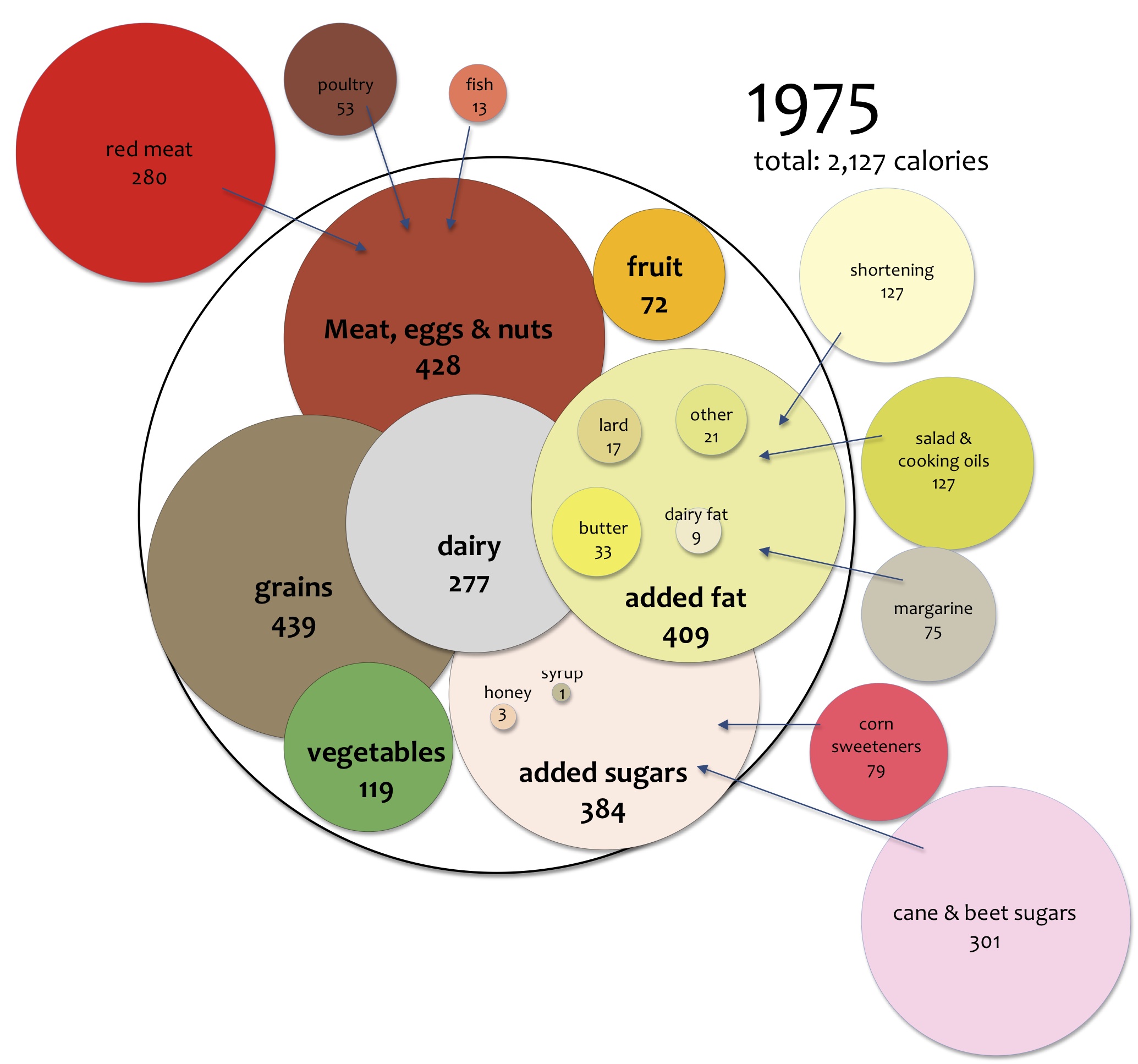
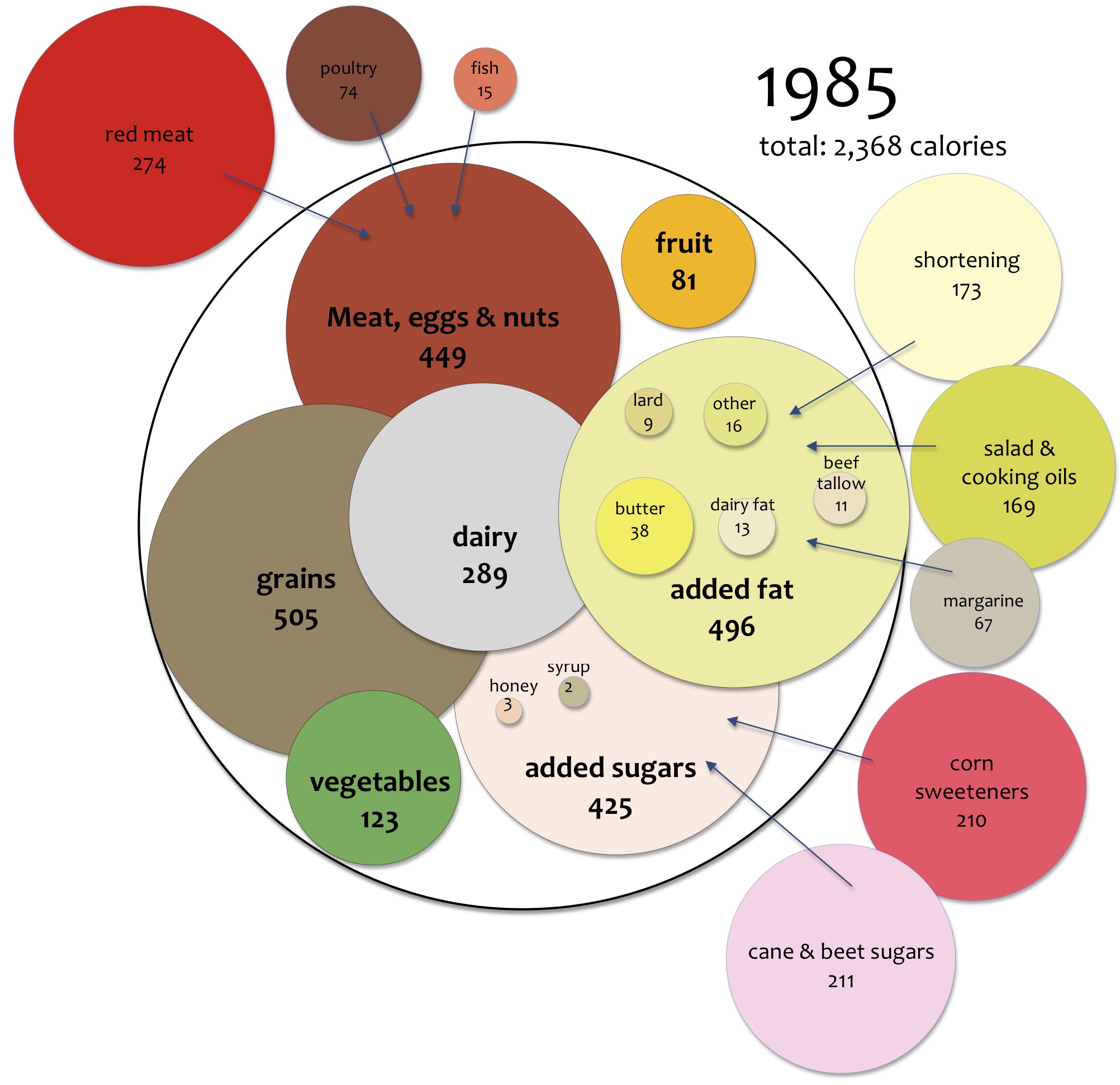
You may have recently seen this graphic depicting general changes in American caloric intake from 1970 to 2005. Take a look if you haven’t. The graphic is very nice visually, but while it accurately portrays USDA data, it’s also inadvertently misleading. USDA’s own categories (shown in the graphic) are very broad and general, but the USDA dataset also includes a more detailed page for each of the categories. And it’s in those details that the trends and changes in the American diet really start to become apparent.

The infographic suggests that fats, with some contributions from grains, sugars, and meats, have accounted for the largest share of extra calories in our diet. But in the details, a few things stand out: First, the fat increase (no surprise here) does not reflect any increase in traditionally-demonized saturated/animal fats, but in vegetable oils and shortening. While the infographic shows a modest increase in sugars (50ish calories), the detailed data reveal a sizable rise in corn-based sweeteners. As for meats, the increase is largely attributable to a rise in poultry consumption, not in often-demonized red meat. These details matter, because the years 1970-present (especially starting in the mid-80s) are also the years obesity in this country has increased dramatically, and too many people still blame the wrong parts of our diet.

I’ve created a slightly-more-rudimentary set of graphics depicting the data from 1970, 1975, 1980, 1985, 1990, 1995, 2000, and 2005 with key details. They’re busier than I’d like, and bar graphs, which I’ve used in the past, show these data better, but I wanted the shapes to correspond to the original graphic, with more detail added. Keep an eye on which sweeteners and fats increase during this period, and which do not. Also, note that much of the dietary increase can be traced back to grains: grains themselves, grain/seed oils, corn sugars and even (although not depicted here) grain-fed meat. Mmm, corn.

(Caveats: the USDA data are not perfect. Some of the fluctuations year-to-year may reflect changes in data collection methods, and the data are themselves somewhat estimated. Also, these are population-level data, which limits the conclusions we can draw about individual health. However, the increase in certain ingredients is of such a scale that it is absolutely worthy of our attention.)

~

Average daily per capita calories from the U.S. food availability, adjusted for spoilage and other waste

Images are original and may be shared freely with attribution. Data source: USDA/Economic Research Service. Data last updated March 15, 2008. Image inspiration from the infographic cited above; please cite that too if sharing.


If you want the original jpegs of these images, send me an email. WordPress resizes these for the post, but the originals make it a bit clearer that the whole-diet circle is also growing. Although, to be fair, I don’t think the general increase in calories in our diet is what matters. Eating more can actually be an effect, and not just a cause, of obesity, as hormones like leptin, which should normally help the body regulate weight and appetite, cease to function properly. Plenty of cultures have thrived on high-calorie, high-fat diets. I’m more interested in what calories we’re eating than how many.


It’s barely April, but I’m getting excited about October. The reason? An event called Food Day, scheduled for October 24th.

It’s being billed as an Earth Day for food, an opportunity to galvanize people from all parts of the food movement and engage new people. The event will include simultaneous activities in cities across the U.S. Organized by local communities, the events will highlight sustainable agriculture, nutrition, access to healthy and delicious food, and strategies to counter the marketing of detrimental junk foods. The focus is broad, ranging from recipe to policy.

That broad focus is part of why I’m excited. Most people working in the food and nutrition movement focus on one––or maybe two––of the core areas: nutrition (healthful or detrimental foods, sustainability, taste/recipes, or access. But, as I’ve often said, these should not be separate categories. Nutritious food is sustainable food, the biggest example of this being that the animals raised on pasture (sustainability) produce not just delicious foods, but fats and vitamins essential to human health. Access to these foods should be a right, not a privilege. When affordable food access is limited, junk food fills a gap.

This event is designed to emphasize that overlap and, ideally, to promote information-sharing between people who specialize in one or two of the aforementioned areas, but not all. It’s also a chance to ask our policymakers for specific changes, to educate and learn from our community, and to share some seriously tasty, local, sustainable eats.

To that end, Seattle: Start thinking about what kinds of events we can do here. The campaign is literally just being launched today, so there is a lot of time to plan. Considering that our mayor is on the event’s advisory council (the only mayor so far, I believe), considering all the people active in various parts of the food movement here, and considering all the delicious, fresh food that’s going to be available in October, I’m pretty sure Seattle can come up with something good.

~

The following is the press release for this event.

WASHINGTON, D.C.—Many of the most prominent voices for change in the food movement and a growing number of health, hunger, and sustainable agriculture groups today announced plans for Food Day—nationwide campaign to change the way Americans eat and think about food. Organized by the Center for Science in the Public Interest, Food Day will bring people together from across the country to participate in activities and events that encourage Americans to “eat real” and support healthy, affordable food grown in a sustainable, humane way.

Food Day will be observed on Monday, October 24, 2011 and will likely include a series of marquee events in Washington, New York City, San Francisco, and other major cities, and thousands of smaller events around the country.

“Food Day is designed to further knowledge, understanding and dialogue about critical topics in food, agriculture and nutrition—spanning the food chain from farm families to family tables,” said Senator Tom Harkin, Chairman of the Senate Health, Education, Labor, and Pensions Committee, and an honorary co-chair of Food Day.  “The many activities and events spurred by Food Day will help foster a robust dialogue on how to promote better nutrition and health, lessen hunger and increase access to food, enhance opportunities for farm families and rural communities and conserve natural resources.  There are differing ideas and perspectives on these issues and surely we all benefit from discussions about the connections among food, farms, and health.”

Modeled on Earth Day, organizers hope Food Day will inspire Americans to hold thousands of events in schools, college campuses, houses of worship, and even in private homes aimed at fixing America’s food system.  A Food Day event could be as small as a parent organizing a vegetable identification contest to a kindergarten class—or as massive as a rally in a city park, with entertainment and healthy food.  Health departments, city councils, and other policymakers could use Food Day to launch campaigns, hold hearings, or otherwise address communities’ food problems.

The campaign hopes to agitate for progress on five central goals:

  • Reducing diet-related disease by promoting healthy foods
  • Supporting sustainable farms & stopping subsidizing agribusiness
  • Expanding access to food and alleviating hunger
  • Reforming factory farms to protect animals and the environment, and
  • Curbing junk-food marketing to kids

“In planning for Food Day, we’ve begun to bring together a lot of people with common interests in food issues, but who otherwise haven’t worked all that closely together,” said Michael F. Jacobson, who founded CSPI 40 years ago. “So whether your primary concern is human health, farm policy, or the quality of life in rural America, Food Day can be an opportunity to organize people together to solve local and national problems.”

Besides Jacobson, Food Day is led by honorary co-chairs Senator Tom Harkin (D-IA) and Rep. Rosa DeLauro (D-CT), and an advisory board that includes author Michael Pollan; prominent physicians including Caldwell Esselstyn, Michael Roizen, and David Satcher; nutrition authorities Walter Willett, Kelly Brownell, and Marion Nestle; public health expert Georges Benjamin; and chefs Nora Pouillon, Dan Barber, and Alice Waters.

National organizations such as the American Dietetic Association, the American Public Health Association, the Community Food Security Coalition, Earth Day Network, the Farmers Market Coalition, the Humane Society, the National Sustainable Agriculture Association, the Prevention Institute, Slow Food USA, and many city- and state-level organizations are planning on organizing or participating in Food Day events.

“Food Day is an opportunity to celebrate real food and the movement rising to reform the American food system,” Pollan said.

Eventually, FoodDay.org will let people type in their zip codes to find Food Day events near them—or to invite people to Food Day events of their own making.

New hot-flash-pasteurization device allows infants to suckle without alleged risk

[Edited to add: Now that the date has passed, and most of you have figured it out anyway, I'll clarify that this was an April Fools' Day piece. Enjoy! -DG]

Readers –– I’m in Washington, DC this week, reporting the latest news from our nation’s capital.

WASHINGTON, 4.1.11. The Food and Drug Administration, long a critic of unpasteurized dairy, announced new restrictions today on a previously-unregulated form of sustenance: mother’s milk. The new rules, which require breast milk to be raised to a temperature of 161 °F (71.7 °C) and then cooled, will go into effect immediately. Women caught breastfeeding infants without first pasteurizing their milk will be subject to fines and, if found in continual violation, liquidation of their assets.

“It came to our attention that individuals were suckling directly from an unbleached nipple,” said FDA spokesman Arthur Steenow. “When we looked at data for the U.S. population as a whole, we realized there was a strong correlation between this intake of unpasteurized mother’s milk and other alarming symptoms, most notably emotional irritability, crying, incontinence, weak limbs, and even a lack of articulate, verbal communication. It became apparent that we needed to move forward with bold action steps immediately.”

While the battle over unpasteurized (also known as “raw”) milk has raged in bovine, caprine and even ovine territories, the inclusion of human milk in the conflict is new.

The exact origin of concerns over unpasteurized breast milk remains unclear. However, multiple sources cite a response to a common lament among breastfeeding women: sore, raw nipples. The FDA, these sources state, began investigating complaints about raw nipples in late 2008, when it stumbled upon the data mentioned by Steenow. After realizing hospitals had received multiple complaints about the raw nipples, the FDA decided to step in and nip the situation in the bud.

However, the agency isn’t planning to leave mothers and infants high and dry. In conjunction with Johnson & Johnson, the FDA is issuing a new product that will allow mothers to pasteurize the milk as it flows directly from the mother’s breast to the infant’s mouth. Known as Hot Mama, the device uses a technique called hot-flash-pasteurization to heat the milk quickly and cool it to a reasonable temperature. The plastic contraption will be available for $29.99 from local drugstores.

But some people aren’t exactly pumped about the news. Raw milk enthusiasts and breastfeeding advocates around the country delivered thousands of signatures to the FDA, objecting to the regulations, and accusing the agency of milking the situation to its own advantage. Many local-food advocates were simply confused.

The FDA is nonplussed. One official, speaking on condition of anonymity, seemed less than empathetic to the public’s concerns. When asked what infants and mothers should do if they object to the new regulations, he shrugged. “It’s the law now,” he said. “Suck it up.”

For more information about the situation, please read the original press release.

Tomorrow: Used-car dealer on Aurora Ave North begins selling the Pacific Northwest’s first local lemons!

I’m about a week late with this news: Thundering Hooves Ranch, which I think was the largest Washington State grass-fed beef supplier, has closed. We still have many great local grass-fed meat producers (Skagit River Ranch, Olson Farms, Sea Breeze, Stokesberry, etc, plus many who don’t sell at Seattle farmers markets but do take orders for CSAs or parts of/whole animals). Still, I’m curious what this says about the current state of (and the future of) access to grass-fed meats in Washington State.

There are two good Seattle Times pieces on the closure, here and here. Someone commenting on one of the articles wrote, “As I understand it from those who were involved, they would have been unable to survive as a small company given the position they were in.” There was a lot of demand for the meat, but there were debts, which seem hard to avoid in the risky business of farming and ranching, and with quick growth.

What does this mean? I’m curious to hear your perspective, especially, but not exclusively, if you’ve been in the business of raising/selling pastured meats yourself. Is the answer to support the growth and sustenance of many smaller grass-feeding ranches, so none is overwhelmed by scale or quick growth, or has such a wide-reaching effect if it closes? Are there ways to bring down the costs for producers? Is the issue that it’s much more expensive to process meats as a small, family ranch than just to sell one’s livestock to a feedlot or intermediary?

Ideally, our system of food subsidies in this country would change. Instead of subsidizing wheat, corn, and soy, contributing to the abundance of cheap-and-unhealthy food that’s costing us more in the long run as we get sick––obesity-related illness makes up a large share of medical costs in the U.S.–– I’d rather we subsidized sustainable producers of vegetables and of pasture-raised livestock for meat, dairy and eggs. That doesn’t seem likely to happen anytime soon, especially given current agricultural priorities. The U.S. House Agriculture Committee, for instance, just endorsed a letter to the budget chairman advocating for saving grain subsidies and cutting food stamps. However, defeatist attitudes aren’t going to get us anywhere; the unlikelihood of succeeding in advocating for different subsidy/spending priorities doesn’t excuse us from the need to try.

The bottom line seems to be that we need more producers of sustainable meat, and we need to find ways to support those producers, whether that’s via subsidies or increased purchasing, or another means. I’m going to start talking to farmers I know, but, in the meantime, I’d love to hear your perspective.

~

EXTRAS:

Terminology note: You may have noticed Thundering Hooves’s website used the term “pasture-finished” to describe their meat. In case you’re not familiar with this, that means that the cows weren’t just raised on grass (or hay in winter) and then sent to a feedlot, they was raised on grass for their entire lives. Cows that get sent to a feedlot typically only spend 3-6 months there, but that’s enough to change the fatty-acid profile of the meat pretty significantly. Some producers advertise their meat as grass-fed, or mostly grass-fed, and then find euphemistic ways to say the cows got sent to a feedlot for a while. Grass-finishing, or pasture-finishing, means that the cows weren’t sent to a feedlot.

Cows frolicking video: I adored this video from Tom Philpott of Grist.org. It shows cows in England frolicking as they’re let out into the spring pasture for the first time after a winter spent eating dried grass and hay when there was no pasture to munch. Remember, the fat from animals on spring pasture, when the grass is growing quickly, is particularly high in vitamins like vit A and vit K2 (MK-4). It’s also very yellow and extraordinarily delicious.

It’s not often that you think you just did something nobody’s ever done before. But today, it might have happened.

It’s Purim, so I’m making the hamantaschen recipe my grandmother z”l developed while she was alive, and passed down to me. It’s my family obligation to make this recipe now every year and send hamantaschen out in boxes (gifts called mishloach manot) to my family and dear ones. I’ve done my best to preserve this recipe; I’ve written it up in the New York Times, I’ve taught workshops on how to make it for two Purims in a row, and I’ve committed to the family hamantaschen-baking role.

But this year, I did something else. You may be familiar with the Sierpinski triangle, a mathematically attractive, self-repeating fractal that starts with one equilateral triangle and breaks down into ever-smaller triangles.

Somehow this year it dawned on me that the world was incomplete without a Sierpinski hamantaschen, or sierpinskitaschen. I scoured the vast reaches of the Interwebs, to see if this had been done before. I may have missed something, but it seems this has not.

Until today.

Very carefully, I have made the possibly-world’s-first Sierpinskitaschen. It’s a little… irregular, but charmingly so. And it smells better than any Sierpinski triangle I’ve ever met.

Nerdecadent to be sure. Tessellicious, as my friend Ben said, although I’m pretty sure these are meant to be given away. And yes, ideas are already in the works for things like a mandelbrot, Mandelbrot set…

Now, just to be clear, I am not a mathemataschen, not by any stretch of the imagination. But I’ve been more and more inspired by math lately (details in a moment). I learned some basic facts about the Sierpinski triangle as i went. First of all, when rotated to any side, it looks the same; I couldn’t even tell where I’d started it. Also, as the triangles get smaller, notice a pattern in the quantity of each size: 1, 3, 9, 27…. I’m sure it would go on if I could make really really tiny hamantaschen, but I don’t have that much power. Also, technically this triangle has no area, so maybe all the sugar doesn’t count? But careful with that logic: it has infinite perimeter, and that dough for the perimeter is full of not-healthy ingredients like flour and sugar and oil.

Watch this stunning video lecture of my friend Dan teaching about the Sierpinski triangle. Watch the triangle grow out of a fractal line or Pascal’s triangle in really surprising ways, and try to guess how many dimensions the Sierpinski triangle has. (You will probably guess wrong, and that will be fun.)

There are many, many more cool things to learn about math and patterns and math and food. Dan from the video is my friend Dan Finkel, who writes www.mathforlove.com with his partner, mathematician Katherine Cook. It is their lovely blog that has inspired my appreciation for math and patterns and the overlap between math and the natural world, and math and playfulness/whimsy. At some less-busy moment in life, Dan is going to write a guest post for Seattle Local Food all about food and math. It’s not just about Romanesco cauliflower, though that’s a pretty cool place to start. In the meantime, check out their amazing blog[Edited to add: The Sierpinskitaschen has been gifted to Dan and Katherine; they blogged about it here.]

~
You too can make this!

Sierpinski Hamantaschen

Start with my grandmother’s recipe. FYI, it’s not gluten-free (or paleo-friendly). Tomorrow I’m going to try a rice flour/tapioca version for myself, since I’ve been good and not eaten a single one of the hamantaschen I’m baking. Also, this is not a healthful recipe. It includes flour, sugar and oil, the trifecta I almost never eat. For the oil, I settle for high-oleic sunflower oil, since the high-oleic sutff is lower in omega-6 fatty acids.

Get yourself a dough scraper, about 5″ wide. You could do this with a knife too, but a dough scraper is a great tool to have around the kitchen for cleaning cutting boards, lifting fragile cookies, assembling hamantaschen, etc etc.

Roll out the dough and cut an equilateral triangle about 10″ on each side. Draw a line down the middle each way. Measure this carefully.

From strips of cut dough, make a triangle in the center, from the middle point of each triangle’s side. These dough strips will not want to stand up. So, use bits of aluminum foil to hold them in place. Quickly fill the center with prune butter.

Next, you’re making the three second-largest triangles. Take a glass about 3″ wide — to get the right measurement, hold it in the place where the next three large triangles will be and see if it fits perfectly. Follow grandma’s instructions for making those into hamantaschen. Place them, with one flat side up rather than one pointed side up (just like your big triangle).

Now, fill all open spaces with a thin layer of prune.

Now, find your next-smallest circle size, probably a little smaller than a shot glass. I used the top of a spice container. Make those into nine tiny hamantaschen, and place them into the fitting holes (consult a picture of the Sierpinski triangle as you do this). Finally, fill in the last spaces with 27 very tiny hamantaschen — I used the top of a bottle of vanilla extract.

Finally, time to make the sides. Roll out strips of dough and drape them around the sides and corners of the hamantaschen, letting them lean in a little.

Bake at 375 till golden brown at the edges.

And share, infinitely. Especially, but not exclusively, with Jewish math geeks.

Rachel is coming home!

Well, technically she’s already come home. But more on that in a moment.

As you might have heard, Rachel, the bronze pig who stands watch over Pike Place Market, charming visitors and raising funds for the Pike Market Child Care & Preschool, Pike Market Medical Clinic, and Pike Market Senior Center & Downtown Food Bank, was involved in a rather serious car accident. In early February, a taxi careened into the market, having been truck by after another vehicle. The taxi was headed straight for Rachel. Fearlessly, Rachel stood her ground (admittedly, she was bolted to said ground) and protected the market. Had she not been there in the taxi’s path, the taxi would have caused far more damage. Rachel was knocked off her base and landed, wounded, on her side.

She spent about a month in the bronze pig hospital getting repaired (oh, that we should all have access to such good health care!). Finally, for the last few days, she’s been appearing around the city, appearing at places like ferry terminals and the Seattle Art Museum. And today, on the back of a 1936 flatbed truck, she’s scheduled to come home to her beloved Pike Place Market. She’s parading from Westlake to Pike Place at 1:30 and all are welcome to come.

BUT. Here’s a little secret: She actually already made a grand entrance (a practice one?) Wednesday on said antique flatbed truck.

Wednesday, I was at Pike Place Market with two friends from out of town, tasting cheese and heading to have lunch. As we wandered along the cobblestones of Pike Place, I was telling them the story of Rachel’s bravery, and how she would be coming back soon. And, no exaggeration, mid-story… we heard honking. My friend looked up and asked, Is that her??” and I saw a 1930s flatbed truck with Rachel on the back turning the corner and heading down the street towards us. People pulled out cameras. Someone shouted, “Rachel! Welcome home!” Two men moved a barrier for the driver, and the truck headed down the street, Rachel standing at attention.

It kind of made my day.

Today! 1:30 pm! Perfect for a lunch break to cheer on the brave pig. Maybe buy some daffodils and spring foods while you’re at it.

Like many local-food advocates, I admire Michael Pollan for the fact that his writing has made so many people aware of the problems with America’s industrial food system, and aware of the value of pasture-raised feeding over less-sustainable, grain-intensive methods. But I’ve been frustrated since he came out with his seven-word soundbite: “Eat food. Not too much. Mostly plants.” It doesn’t take into account the problems with calorie-counting as a nutritional approach, or the fact that we need––and are deficient in––large amounts of vitamin forms and fats found only in animal products. But I suppose I’ve been too lazy to come up with a better, catchier soundbite.

Laziness has paid off. Another blogger, Craig Fear of Pioneer Valley Nutritional Therapy,has gone ahead done it, in a nicely detailed article on some of the reasons Pollan is wrong.

Craig’s soundbite: Eat real food. Eat a lot. Mostly local.

I love it. Check out Craig’s full article here.

Take one part mid-March, one part cabbage, and one part meat, and stir into the collective mind. I’m guessing Irish food comes to mind, with its cabbage and corned beef or its stews of lamb and cabbage and wintry vegetables.

But you’d be surprised how versatile these humble ingredients can be. This dish is a little less Ireland, a little more Italy. I’m okay with that; as much as I love Ireland, Italy has better weather right now anyway. And fantasizing about better weather is about as tantalizing to me right now as taking a break from studying to make a delicious-yet-easy lunch.

This is another (Paleo/low-carb/celiac-friendly) dish for people seeking or willing to try interesting substitutes for noodles. I do eat rice pastas sometimes, but try to limit my grain intake. Plus, substitutions often have a lot more flavor.

In this case, I’m sautéing strips of green cabbage in a whole lot of good butter with a pinch of salt, and then testing it with different kinds of sauces. The trick is that you only want to use the top half of the green cabbage for this, before the harder white part starts. Save that for stir-fry.

For a few friends recently, I made cabbage like this with caramelized onions, mushrooms, cream, parsley, saffron, and dried cherry tomatoes, a little like a pasta with cream sauce. It didn’t taste like noodles, but it did taste like a delicious and fatty cabbage dish.

Today’s experiment: a simple lamb-tomato sauce. Really easy. The kind where you throw two cloves of chopped garlic and a patty of ground lamb into a pan with some olive oil, stir and add salt, add some tomato sauce, and simmer until your cabbage is done in pan #2. It works really well. The cabbage has most of what you’d want from a noodle: it’s chewy, flexible, buttery, and well-matched to the flavor of the sauce. The chunkiness of the sauce from the meat doesn’t just make this more filling and healthful, it helps the dish avoid being too watery, since cabbage doesn’t absorb sauce the way a traditional noodle does. If you have sauce left, well, that’s what spoons were made for.

Easy. Healthy. Tasty. Filling. Faster than boiling pasta.

Back to studying for biostats!

~

Buttery Cabbage Noodles with Lamb Tomato Sauce (Grain-Free)

per serving:

  • Top half of a very small green cabbage, or half-of-the-top-half of a large green cabbage (only the green part, none of the white stem!)
  • 1/4 lb ground grass-fed lamb (available at PCC or the farmers market)
  • 1 cup tomato sauce (store-bought or home-canned. If I’m buying it in the store, I prefer ones without tomato paste or sugar or oregano; they seem to be better quality)
  • olive oil
  • salt
  • 2 cloves garlic
  • lots of butter (3-4 T)
  • parmesan, pepper, etc to taste

1. In one pan, heat olive oil to medium heat. Add ground lamb and break up with a wooden spoon. Add garlic. Stir, salt, adjusting the flame to make sure the oil doesn’t smoke.

2. When the meat is browned, add tomato sauce. Stir to coat, turn the heat down very low, and leave alone. You want the flavors of the lamb and tomato to combine well, and you want the sauce to thicken, so it’s not runny on the cabbage.

3. Slice your cabbage. Remember, you’re using only the top portion, where the leaves are thin and green. I cut the cabbage in half around its waist and then in half again top to bottom, so it’s easy to slice off strips. Cut them about the width of fettuccine, maybe 1/4 to 1/2 inch.

4. In pan #2, heat a lot of butter. Add cabbage. Stir. Add more butter as it absorbs yours. Add a little salt to taste. Cook until the cabbage is completely wilted and slightly brown in a few places, about seven minutes.

5. Arrange cabbage on the plate. Arrange sauce on top. Add any extras you’d like, such as parmesan or black pepper or parsley or even things that don’t start with a p, if you’re feeling really adventurous. Serve.

Spring is coming! Yeah, so maybe it’s still cold and rainy and we haven’t seen many springtime ingredients yet. But some nettles are starting to come up, as are some other early greens, both wild and cultivated. And one of these greens is probably right in your yard, if you have a yard, and you probably want to pull it up anyway.

That’s right, it’s dandelion green season. Dandelion greens are best when they’re very young, with thin, narrow leaves growing in a rosette that hasn’t yet produced a flower. They’re slightly bitter in a good way, they’re delicate, and they don’t get slimy like spinach when cooked. They make great pesto too, if you have the patience to pick enough and clean them.

They also go fantastically well with one of the other few things we’re getting already this season: leeks. Sauté the two together in some yellow springtime butter with a little salt, and the leeks get a certain sweetness that perfectly balances the dandelion greens’ flavor. So very tasty.

The result is great on its own, mixed with mild spring cheese, tossed onto scrambled eggs, spooned on top of broiled meats, stuck into the center of buckwheat crèpes… Basically, use it anywhere you’d like a savory flavor. I ate mine with scrambled eggs and a bit of some fresh cheese my friend kindly left in my farmers market bag on Saturday.

It seems silly to write this in recipe form, but here you go.

~

Dandelion and Leek Sauté

Ratio:
Handful of dandelion greens (see notes above)
per every 1 smallish leek

1. Remove roots of leek and outer hard layer(s). Wash well. Slice into thin strips.
2. Heat butter. Sauté leeks on low heat (they burn easily). Add a pinch of salt.
3. Add dandelion greens. Stir until wilted. Taste to adjust salt.
4. Add to any other recipe or eat as is.

NPR reported today on a new study in The Lancet in which researchers examined whether dietary intervention can improve ADHD symptoms in kids. Researchers found a significant decrease in ADHD symptoms with the specific diet. Kids in the study ate an elimination diet primarily of rice, meat, vegetables, pear and water, although I  was surprised to see they included some supplementary wheat as well.

This is not the first study of ADHD and diet. Another review of 35 years of dietary research suggested kids with ADHD are sensitive to artificial food colorings and preservatives, and that this sensitivity typically co-presents with sensitivities to milk, chocolate, soy, eggs, wheat, corn, legumes and sometimes grapes, tomatoes, and orange.

I’m curious about the inclusion of wheat in the Lancet study because there’s some interesting research about gluten and ADHD. Some of this research focuses on people with celiac disease specifically, such as one study of children and adults that suggested untreated celiac disease (e.g. people with celiac disease who still eat wheat, rye and barley) can manifest ADHD-like symptoms. In another, admittedly small study of children with autism, some of whom also had ADHD symptoms, researchers removed gluten and casein (which comes from dairy) from the diet and found significant improvement of ADHD symptoms among the ADHD subset.

But gluten can’t be the whole picture, as the newer study suggests. Of course, it’s rare that only one dietary component is responsible for large-scale effects on the body, even with obesity. I’d like to see more research on the role gluten plays.

For those who may have gluten intolerance and may not know it, it’s worth leaving gluten entirely out of your diet for a minimum of three weeks and seeing whether your health improves — you may see other surprising effects, like an improvement in lactose tolerance. And maybe you’ll also find improvement in your, uh, your… Hey! Wanna go ride bikes???!!!

Okay, where was I. A friend also brought up the question of sugars and ADHD. The research on this could be better, but it’s interesting. A lot of it seems to focus on short-term changes in symptoms instead of effects of a longer-term dietary change. One study showed significant immediate response of ADHD symptoms in kids fed sugars/high-carbohydrate breakfast. Another study found no significant effect of sugars or food dyes.

My guess is that sugars play a long-term role in worsening ADHD symptoms, and I’d like to see more research. I’d especially like to see fructose/high-fructose corn syrup examined in more detail, considering its unique relationship to changes in metabolism and weight (study – full text!). Also, trace mercury, which can also contribute to ADHD, has been found in HFCS (full text) .

There’s a camp among nutrition folks that, in response to this kind of research, will say just, “It’s what we know; eat a diet of whole foods and you’ll be fine!” I don’t precisely agree with this. “Whole foods” is a very vague term, for starters. It doesn’t account for changes in the nutritional value of food from, say, changes in how we feed animals or treat soil. It includes all grains, not accounting for some of the real health problems associated with gluten, or for historical changes in how societies treat grains (e.g. no longer soaking, sprouting or fermenting them).

But some of that general message is right, in that what people commonly refer to as whole foods don’t contain added sugars or dyes or preservatives. Still, I’d change the message to something like: Eat whole foods from animals raised on pasture and vegetables grown without pesticides. Avoid or limit gluten grains, and treat other grains traditionally. Limit the other stuff, and do what’s right for you.

And now, go ride bikes!

~
Thanks to citymama for the Creative Commons photo.

Here’s a recipe that will appeal to fans of Thai food, paleo/low-carb eaters, people who want yet another delicious Thai-inspired use for Stokesberry Farm’s ground chicken and local tasty winter vegetables, or anyone who wants to try something new.

Pad woon sen is a particularly delicious Thai noodle dish. Woon sen are thin glass noodles made of rice or bean; in pad woon sen they’re typically stir-fried with meat, vegetables, sauces and egg. I make the dish now and then, or sometimes enjoy it out (Chayo on 15th near Northgate makes a mean pad woon sen). But it is kind of a large tangle of carbohydrates and leaves one a little sleepy. But…

Not too long ago, I was shopping at Madison Market and saw something in the refrigerator case that caught my eye: a package of what looked like woon sen noodles, except they were actually kelp. I couldn’t resist; I bought them.

I kept putting off cooking them. They keep many months in the package and, honestly, since I hadn’t tried them, it felt like a gamble. There were too many nights when I was busy with homework and wanted to cook something familiar and reliable. What if they were terrible, and I had to eat something bad while doing homework, or waste food/time cooking something new? I’d open my fridge it would say, “Make your mother’s roast chicken; it’ll cook while you study.” or “Don’t you want the rest of that onion soup in the freezer? I thought so.”

Note that if your fridge is talking to you, you might want to start getting more sleep.

But my fridge was secretly conspiring with the package of noodles. The fridge slowly talked me into getting all the right ingredients, unaware of what I was doing. And so, yesterday, when I finished a deadline and opened the fridge, I heard: “Look. You can defrost that ground chicken in the freezer. Meanwhile, we have shiitake and oyster mushrooms, carrots, onions, broccoli, spinach, napa cabbage, garlic, eggs, a lime, and those damned kelp glass noodles. Do ANY of these things not go together?”

My fridge had a point. That was pretty much the makings of a perfect pad woon sen. (Also, I really needed a nap.)

I tasted a kelp noodle. It was a little crunchy. I was a little skeptical. But I was done with a deadline, and decided I’d cook this anyway. It only took a few minutes: Throw the garlic and onion in the wok, add some fish sauce (soy or other sauce optional), add carrots, cook till soft, add mushrooms… Cook in the chicken, add the broccoli and cabbage and noodles, add eggs and stir until cooked. Maybe ten minutes.

Reader, I ate it. The kelp noodles lost their salad-like crunchiness in the wok. They were pretty much just like the regular woon sen noodles except less chewy (and woon sen is a little too chewy, if you ask me).

The only thing is, these noodles are made pretty much of water, sodium, and calcium. True, they have almost no carbohydrate (1g) but they have almost no *anything* — which is to say you really want to make this dish with meat or something substantial, or you’re going to be hungry again pretty quickly.

~

Pad Woon Sen (Sea Kelp version) With Ground Chicken, Winter Vegetables and Egg

NB: This recipe is very approximate in ingredients and proportions. You can modify it to taste like any kind of stir-fry you like to make. Fish sauce is essential for Thai flavor, and spices or ginger make a nice addition.

  • 1 package kelp noodles (available at Madison Market and possibly elsewhere
  • 3/4 – 1 lb ground chicken (Stokesberry has this at the U-District and Ballard farmers markets)
  • Assorted winter vegetables (garlic, onion, carrots, napa cabbage, mushrooms — the shiitake and oyster mix from the U-district market worked beautifully, broccoli, etc)
  • 2 eggs
  • fish sauce
  • soy or other Asian stir-fry sauce (optional)
  • coconut oil or chicken fat (schmaltz; Stokesberry has this, although the amazing jar I have is one I got in San Francisco)
  • 1 lime
  • a pinch of sugar (optional; you can also use Thai palm sugar which is not very sweet at all)
  • hot sauce to serve (optional)
  • other flavors, like ginger or hot peppers, as desired


1. In a wok, stir-fry onion and garlic in oil or fat. Add a few dashes of fish sauce. Add carrots and stir.

2. Add a bit more fat/oil and add mushrooms. Cook until they emit liquid.

3. Add ground chicken and any other flavors (ginger, hot chilis, etc) and stir until cooked. You can add the optional pinch of sugar at this point.

4. Add other vegetables and cook for a minute or so.

5. Add kelp noodles and a little more oil/fat. Stir to combine.

6. Make a hole near the bottom of the pan for two eggs, and crack eggs into it. Let them cook a minute undisturbed, then break them up with your spoon and stir them throughout.

7. Add lime or any other flavors (taste and adjust), stir, and serve hot.


I just got an update about this event. Please attend! The poster is shown here. RSVP by February 18th. Support small family farms like Estrella Family Creamery, as they fight the FDA action, and brainstorm together how to solve the problems our region faces around food sovereignty and sustainable food production.

Mini Quiche Cakes

This recipe happened by accident.

Here’s what I was going for: I’ve been making quiches with alternative crusts. Sometimes frittata-style/crustless, sometimes gluten-free, often nut-based. Recently I made a quiche whose crust was made of thinly-sliced potatoes (you could also use sunchokes) that I’d layered throughout the pie pan bottom and sides, covered in olive oil and a little salt, and pre-baked before adding the quiche filling and baking again.

Some of the potatoes were colorful deep purples and pinks. I wondered, what if I made the same thing, but in ramekins? Could I turn it upside down and get a little quiche dome coated with a thin dome of nicely-colored potatoes?

It turns out the result if you do that doesn’t work very well; it’s better to leave the quiche in its container, because the potatoes don’t hold a great shape.

But. BUT!

I had some left over little bits of potato, so I made a few ramekins where the potato slices were placed with a bit more space in between them, allowing quiche filling to come through. The result? These nice little cakes, browned at the edges, cheesy on the bottom, and full of quiche deliciousness.

Great brunch food. You could probably also reheat these for a few breakfasts.

~
Mini Quiche Cakes

makes four ramekins

  • a few very small, colorful potatoes
  • 4 ramekins or ceramic baking cups
  • 2 eggs
  • ~ 1/3 cup cream
  • 1 egg
  • 3-4 mushrooms sliced or chopped
  • small handful italian parsley chopped fine
  • other greens (spinach, kale, collard) chopped fine
  • cheese (gruyere, swiss, cheddar) grated
  • salt, pepper and nutmeg to taste
  • a teaspoon of flour (I use rice flour. This is optional)
  • olive oil
  • butter


1. Preheat oven to about 385 (somewhere in the 375-400 range depending on your oven)

2. Slice potatoes into thin pieces and cut the slices so they’re about an inch across. All shapes are fine. In a bowl, coat these slices with olive oil and sprinkle salt on them. Arrange the slices in the ramekins, on bottoms and sides. Allow space between them.

3. Gently place ramekins in oven and bake until potatoes soften, probably about 10-15 minutes. If some slices have fallen off the sides, gently put them back in place.

4. While the potatoes are cooking, start your filling. Slice onion thin and cook it slowly in butter with a little salt until all pieces are either browned or clear.

5. Add a little more butter and olive oil, and add your mushrooms, letting as many slices touch the pan as possible. Turn when browned, and cook until they release liquid.

6. Add parsley and stir for a minute. Add greens and cook until done.

7. Flavor: Add nutmeg, pepper and salt to taste. Also, add the teaspoon of rice flour and stir well. This helps it stick to/combine with the egg later.

8. In a bowl, whisk eggs with cream. Add a pinch of salt and a little more nutmeg. Mix in your vegetable filling.

9. Pour the filling into the ramekin cups, taking care not to knock all the potato bits off the sides. Grate cheese on top, which will become the bottom.

10. Bake until done, about 20 minutes. Let them cool slightly before running a knife around the sides and turning them onto a plate.


Enjoy!

More pictures of the successful cakes:

Here, on the other hand, is what happens when you try to coat the ramekin fully with potatoes:

Better to leave these experiments in their containers. :)

The New York Times has an article today that you should check out if you’re at all interested in the ongoing tensions over raw milk cheeses and federal regulations. The FDA is reviewing the rule that requires cheese makers to age any raw milk cheeses a minimum of 60 days before sale. Apparently, the FDA is being pretty silent on what changes, exactly, are being proposed, but there is some concern that new regulations might extend the 60-day period or ban raw milk cheese altogether.


Today (starting last night) is an obscure Jewish agricultural holiday called Tu B’Shevat. It’s literally the New Year for Trees. Way-back-when, people needed a date to restart the agricultural calendar each year, and this date was chosen, being around the time of year the almond trees were in bloom.

A lot of modern sustainability-focused Jews celebrate Tu B’Shevat as an ecological holiday, a chance to talk about issues like land use, climate change, forest preservation, or sustainable food. For the last two years, I’ve hosted a seder and meal focusing on local foods.

The traditional seder includes the seven species of Israel, as well as fruits with small and large seeds, to represent the usefulness of different kinds of deeds. For our seder, we added the (very traditional, dating back to as long as a year ago!) seven species of the Pacific Northwest: salmon, huckleberries, nuts, greens, apples, honey and wild mushrooms. You could certainly argue for other items to be included on that list, but it IS January.

Oy, January. There are, of course, no almond trees in bloom in Seattle. This is a cold, wet time of year, when local vegetables make themselves scarce and local residents hibernate. If anything, that almost makes it a better time of year to have a local foods feast. Everyone knows the Northwest grows a lot of great produce in July, but there’s an assumption that eating local foods in January means basically gnawing miserably on an old, wrinkled turnip.

But instead, with a little help from frozen, preserved, and non-local ingredients (some spices, olive oil, a little grain, a little lemon, etc), we managed to produce: Broiled salmon, mushroom-bean cassoulet, leek-mushroom quiche, roasted brussels sprouts, salad with pears and hazelnuts, cabbage salad, potato-onion gratin, butternut-apple soup, apple-cranberry cake, mixed berry crisp.  I think that’s it. A bunch of wine too, of course. The meal had to be vegetarian/fish only for kosher rules, or the menu could have been even larger with the addition of red meat and poultry.

So, hooray for an agricultural holiday giving us an excuse to enjoy some of the best things possible: the company of friends, the food of the place we live, the chance to reflect, the delight of leftovers.

Friends and blog readers may remember that my grandmother was braving pancreatic cancer these last few months. She left us last Thursday. My heart is pretty torn up about this, even if my mind knows all the right things: that I’m so lucky to have had such a wonderful grandmother, that it is better she is no longer in pain, that she went the way she wanted (at home, in full control), that she’ll always be a part of me.

What can I say? I’m human; I wanted her here forever. I wanted her here for every rite of passage I go through, every meal I cook, every moment I feel a need to call and cheer her up or be cheered or find out what amazing foreign film she’s discovered that I need to see. I’ll always grieve her, and I’ll always remember her. And I’ll do my best to keep her alive as part of who I am. To honor her generosity, her honesty, her love, her passion for living, for justice and arts and reading and learning and ideas…

My grandmother was never interested in doing things half-assed. Her most treasured recipes reflect this. Her recipe for blintzes is a fine example, with detailed instructions that, she always said, most people wouldn’t bother to follow, but must be followed for the end result to be perfect. You have to press the cheese, for instance, through a wire sieve/strainer with holes larger than is found on those typically made these days. Otherwise the consistency is wrong.

My grandmother believed in sharing recipes. I posted this one a long time ago (on the old blog), but I’m sharing it again to honor her memory. Here are very detailed instructions on how to make the world’s most delicious blintzes. If you make and enjoy them, think of the remarkable woman who took the time to create this recipe, who loved feeding and nurturing others, who knew that living life means being engaged with it fully, learning as much as possible, and trying to do the right thing.

I’m spending the week with family and old friends as my own version of sitting shiva, or mourning.  As I travel, her wide-holed strainer and her blintz pan are in my suitcase.

~

Grandma’s Extraordinary Blintzes

Leaves/Wrappers:

  • 4 eggs
  • 1 cup flour* (Note: I usually present gluten-free recipes.  This recipe follows her original instructions, but soon I’ll be working on a gluten-free version.  I’m guessing that a fine-ground rice flour, such as sweet rice flour, with a tablespoon of arrowroot powder will work.  For low-carb/low-grain eaters, each blintz actually has very little flour). *UPDATE 6/7/11: substitute 2/3 cup tapioca flour and 1/3 cup fine white rice flour for a gluten-free version. It works beautifully!
  • 1/2 teaspoon salt
  • 2 teaspoons sugar
  • 2/3 cup whole milk
  • 1/3 cup skim milk or water (Note: You probably know I think skim milk is a terrible idea, but she said they’re too heavy if it’s all whole milk.)
  • 2 teaspoons melted butter

.

FILLING:

  • 8 oz cream cheese
  • about 1/2 – 3/4 lb farmer cheese
  • about 3/4 cup cottage cheese
  • 2 eggs
  • generous pinch of salt
  • 2 teaspoons sugar

~

Make the batter for the leaves/wrappers in advance and let it sit overnight.

1. In the blender, combine dry wrapper/leaf ingredients and eggs. Add milk. Do not add melted butter yet; you don’t want it to sit overnight. You’ll add it in when you’ve taken the batter out of the fridge to use, and let it turn to room temperature.  Cover batter and refrigerate.

2. For the filling, you want to find a way to fluff up the farmer cheese and cream cheese. My grandmother took a strainer with holes about the size of a pencil eraser, and smushed first the farmer cheese and then the cream cheese through these holes with a wooden spatula. It takes a while, but it actually makes the cheese the right consistency. Where you’ll find a strainer like that, I have no idea. I just work here.

3. Mix together the fluffed cheeses. Add the eggs, salt, and sugar and stir.

4. To make the leaves, heat a small, thick crepe pan – hers is about 6” wide. Melt butter into it and leave the flame at medium-low. Pour in some of your batter, swirl it around, and immediately pour the excess back into your container. Wait a moment, and run a butter knife around the edges, then turn out the leaf onto an overturned shallow bowl. Do not cook the other side. Repeat for all of your crepes.

5. To assemble, place each leaf cooked side up on your work surface. Add a few tablespoons of filling, and fold them into squares with the uncooked side of the crepe on the outside, and
each of the four edges folded in. “Like pocketbooks,” my grandmother explained several times. I’m still not sure what that means.

NOTE: If you want to freeze them, this is the ideal stage to do so. Wrap them flat (not layered) in aluminum foil, and freeze them until you’re ready to fry them. This recipe makes about 20 blintzes, so it’s enough to freeze if you’re not feeding a group.

6. When it comes time to fry them, defrost your packets if you froze them. Heat butter in a heavy frying pan until the butter is golden brown and tiny bubbles appear. Turn the heat down to low or medium-low and place the blintzes folded side down (because that side is thicker) in the pan for about five minutes.

7. When the bottoms are nice and brown, turn the blintzes over for a few more minutes. They should be browned on both sides. Work gently with a spatula, because they tear easily. When they’re done, gently place them on plates. It’s traditional to serve blintzes with sour cream, and also with some fruit.

~

This was my grandmother making blintzes a few years ago:

[Okay, so technically food justice starts with "fo" but this looks like a fantastic event for a good cause.  Details below!]

~

Food Justice Starts with Us! — A benefit event for Clean Greens Farm & Market

Saturday January 29th 2011, doors open at 5:30pm
@ Garfield Community Center, 2323 East Cherry St. Seattle, WA 98122
Tickets $35, can be purchased at http://www.brownpapertickets.com/producer/25870

.

From the organization:

“Clean Greens Farm and Market is happy to announce our first annual ‘Food Justice Starts with Us’ Dinner Event, taking place on Saturday, January 29, 2011. The goal of this event is to raise funds for Clean Greens’ food justice projects, as well as to raise awareness of the food access issues that our local communities face.

For our first-ever fundraising event, we will be serving a meal cooked with local, seasonal foods by members of the Clean Greens community. Clean Greens welcomes Brahm Ahmadi, co-founder of People’s Grocery in Oakland, CA, who will be giving a keynote on Oakland’s food justice movement. Towards the end of dinner, a short film on Clean Greens’ ongoing food justice work will be premiered. After dinner, we will be having a dessert auction, and guests can enjoy their dessert while listening to a local jazz band perform.

Founded in 2007, Clean Greens is a food justice organization that is owned and operated by residents of Seattle’s Central District. Our mission is to decrease the incidence of disease in our communities by increasing residents’ access to healthy, pesticide-free produce at affordable prices. We are committed to delivering clean produce to all people in our communities, which we grow on our 22-acre farm in Duvall, Washington, and distribute via our Central District farm stand and CSA program.

We hope you will join us for dinner on January 29th, to learn more about the food justice efforts of Oakland and here at home because ultimately, Food Justice Starts with Us!”

It’s wintertime, and the weather’s been unusually cold.  This is not, traditionally, the season when a young (wo)man’s fancy turns to orchard-keeping and permaculture.

But why not?  Start thinking now about that new chicken coop you want to build, what to do about that homely apple tree in your yard, and whether maintaining a thriving beehive would give you the double benefit of providing free honey and drowning out your neighbor’s kid’s tuba practice (it probably won’t; sorry). Spring is, we like to think, not too far off.

~

Here are a few upcoming classes from City Fruit and Seattle Tilth.

The headings for each category link to the organization’s page for registration information.

~

Seattle Tilth Urban Livestock Classes

Backyard Beekeeping 101 (Good Shepherd Center; 4649 Sunnyside Ave. N., Room 107, Seattle, WA 98103, from Jan 15, 2011 10:00 AM to Jan 15, 2011 12:00 PM)
Learn the fundamentals of beekeeping!
Starting With Baby Chicks (Good Shepherd Center; 4649 Sunnyside Ave. N., Room 107, Seattle, WA 98103, from Jan 15, 2011 02:00 PM to Jan 15, 2011 04:30 PM)
Learn the most important considerations in caring for baby chicks.
Backyard Beekeeping 101 (Good Shepherd Center; 4649 Sunnyside Ave. N., Room 107, Seattle, WA 98103, from Jan 29, 2011 10:00 AM to Jan 29, 2011 12:00 PM)
Learn the fundamentals of beekeeping!
City Chickens 101 (Good Shepherd Center; room 107, 4649 Sunnyside Ave. N, Seattle, WA 98103, from Jan 29, 2011 02:00 PM to Jan 29, 2011 04:30 PM)
A comprehensive introductory course for those interested in keeping chickens and want to start with adult birds.

~
City Fruit Orchard, Permaculture and Beekeeping Classes

Fruit Tree Biology and Orchard Management

Saturday, January 15, 10 am – noon
Phinney Neighborhood Association: 6532 Phinney Ave. N, Seattle, WA 98103

Understanding the basic systems of a tree –its root, vascular, and photosynthesis/leaf systems—helps you better care for your trees and produce healthier fruit. The class covers basic tree biology and orchard management month by month—when to prune, thin, manage pests, etc. Finally, the class discusses orchard safety (especially ladder safety) and basic tools and equipment. Ingela Wanerstrand, is the owner of Green Darner Garden Design, specializing in edible garden design. Ingela has been pruning fruit trees professionally for 15 years, works with the Friends of Piper’s Orchard and Plant Amnesty, and receives high marks for teaching.

Mason Bees for Pollination
Saturday, January 29, 10 am – noon
Phinney Neighborhood Association: 6532 Phinney Ave. N, Seattle, WA 98103 (location tentative)

North America is in the midst of a pollination challenge with the honeybees; our fruit and garden crops suffer as result. Native, non-aggressive mason bees can dramatically increase fruit yields while improving the entire city ecosystem. Take action on the pollination challenge in your neighborhood by learning to manage mason bees. In this class, you’ll learn how to be successful in raising mason bees, you’ll see fun techniques to try in your yard, and you’ll receive hands-on experience with harvesting mason bees. Instructor Dave Hunter has been working with mason bees for nearly 20 years. He has been partnering with US scientists, University researchers, the ARS/Logan Bee Lab, and multiple experts across the country to help gardeners become more aware of their pollination requirements. He recently opened the website www.crownbees.com to assist gardeners with successfully raising mason bees.

Fruit Tree Pruning Basics

Saturday, February 5, 10 am – noon
Phinney Neighborhood Association: 6532 Phinney Ave. N, Seattle, WA 98103

Regularly pruning fruit trees improves their overall health, appearance, and can even increase fruit production. In this beginner class, learn the biology behind pruning fruit trees, practice basic pruning cuts, learn about pruning tools and get hands-on experience pruning a fruit tree. Bill Wanless is co-owner of brooke/wanless gardens, specializing in pruning of small trees, shrubs and vines. He is an ISA-certified arborist with 20 year’s field experience.

Planting and Caring for Young Fruit Trees
February 19, 10am-noon
Martha Washington Park (Location Tentative)

Before you get your fruit trees at the nursery this winter, come learn how to choose the right tree and the best planting and care techniques to give your trees a head start. This popular class covers site selection, considerations in selecting trees, how to plant them and how to care for young fruit trees. You will get hands-on experience planting a tree, so dress accordingly. Jana Dilley works on the Green Seattle Initiative with the City of Seattle Office of Sustainability and Environment. She has a master’s degree in Forestry and in Public Affairs and has organized community tree-planting events in Seattle and California.

Pruning Fruit Trees to Produce More Fruit

Saturday, March 5, 10 am – noon
Jackson Place Co-housing: 800 Hiawatha Place S, Seattle, WA 98114

Learn the biology behind pruning fruit trees and get hands-on demonstrations of how to clean up old trees, how to train very young trees, and how to prune to produce more fruit. Jackson Place Co-housing grows apples, pears and plums in a highly urban environment and has both well-established and very young trees.

Grafting New Fruit onto Existing Fruit Trees

March 12, 10 am – noon
Bradner Gardens Park classroom: 1733 Bradner Place S, Seattle WA (Location Tentative)

This course provides an introduction to the whip graft, cleft graft, bud graft and pleach. You can practice grafting and learn the in’s and out’s of rootstocks. Instructor Greg Giuliani grew up on a Snoqualmie Valley farm with a 1930’s orchard. He learned how to graft in order to re-create these heritage fruit varieties, not available in stores. He has been a member and instructor with the Seattle Tree Fruit Society for twelve years.

Permaculture and Orchards

Saturday, March 19, 10 am – noon
Phinney Neighborhood Association: 6532 Phinney Ave. N, Seattle, WA 98103

In this hands-on class, learn permaculture best practices for planting and maintaining healthy fruit trees. The class will discuss how to establish “plant communities” (also known as permaculture plant guilds) that activate the soil, support the ecosystem, and promote low maintenance tree health. We will also cover sheet mulching and companion planting. Co-instructor Jenny Pell is a permaculture teacher, designer and consultant specializing in urban permaculture, edible perennials and vertical gardening. Details about her projects are at www.permaculturenow.com . Jacqueline Cramer has worked the land for twenty years as farmer, teacher, gardener, designer, and activist, and has worked in urban settings designing, installing and maintaining landscapes, including over 15 school food gardens.

For those of you who haven’t heard, the FDA has also shut down the business of long-time local raw milk cheese maker Sally Jackson (Seattle Times article here). It’s a shut-down with controversies about E. coli and cleanliness, but I’m going to put that particular discussion aside here, since the debate is already taking place in various other places online.

Instead, I’m trying to think about the big picture of how we prevent this from happening to small farms and cheese makers, whether you think the fault lies with the FDA, with food producers themselves, or in some more nuanced combination, depending on the individual case. Perhaps there’s a more systemic way we can look at this.

Whatever your position, the loss of a business like Sally Jackson’s is sad. It’s sad for her; it’s hard to make your livelihood running a small food operation in a country of giants, to take that risk with your financial future. Also, for the rest of us, her cheeses were delicious. She was making artisan cheese when the idea wasn’t even a twinkle in this locavoracious community’s eye. Compared to, say, Europe, we don’t have enough makers of artisan cheese to go taking them for granted (not that we should even if they were plentiful).

Perhaps those of us who agree that it’s sad to lose small, artisan producers can think about solutions together. We have common ground, whether you feel farmers/food producers are getting a raw deal, or whether you believe the result is sad, but the producers may have made mistakes.

The idea I’ve been thinking about: Some form of legislation that would help small producers when this happens, such as a financial allotment to remedy the situation when a producer below a certain size is subject to an FDA recall. The real barrier seems to be financial. If the FDA recalls a product for a large corporation, the corporation has enough funds to take a quick loss, fix the problem, and stay in business. But for a small producer, a recall of tens of thousands of dollars in cheese sounds pretty terrifying.

If we can agree that in general it is a good thing for the country to have small, unique producers as well as giant food corporations, such a bill would help preserve that idea. Yes, sometimes funds would go to small producers who made mistakes or perhaps even took careless risks with the public’s health. But this idea is about both helping families running small businesses and helping us continue to be a country where small producers can actually do business. For those of us who believe in that goal, helping any small producer is valuable. Otherwise, who’s going to take the risk of starting a new family dairy farm or cheese-making operation?

Not everyone agrees America should have small producers. There are a lot of corporate dollars influencing government in this country, obviously. But it’s an idea that attracts people from all over the political spectrum, from the far left to the far right. I’d be interested to see who would get behind it.

Thoughts?

~
Credit to Stephanie Kilgast for the flickr Creative Commons photo

A childhood friend, chef Peter Shelsky, tipped me off to a program on New York’s public radio station WNYC this morning, as thanks for tipping him off to my favorite restaurant in New York.  My favorite Egyptian chef, Ali El Sayed from said restaurant — the Kabab Cafe on Steinway Street in Astoria (Queens) — was going to be on the Leonard Lopate show talking about Egyptian food, Peter said.  The link is here.  The problem is, I’m now craving this food again even though I was just in New York, and eating there, a week ago.

I also just found this recent PBS video interview with him too.

Ali is not just a genius with ingredients, he’s delightful to listen to, especially when he talks about food (although he has plenty to say about art and life and culture too). Whenever I visit New York, I make it to his itsy-bitsy restaurant and perch at a table with my friend Karyn, chatting with Ali while he tells us things like, “When you make falafel (out of favas!), you should behave like you’re making a soufflé. They’re very delicate.” Indeed, his falafel are light and flavorful and addictive. He makes lamb stuffed with ground lamb and ground nuts and spices, lamb chops with pomegranate sauce, gorgeous chickens, and exquisite-yet-simple desserts (I still drool when I think about the blueberry clafoutis I had the first time I went there).

I don’t normally write about restaurants, and this place isn’t even in Seattle. But listen to the interview with Ali, especially if you’re inspired by people who love food, by the history of food, or by the idea of making something tasty in your own kitchen. And if I work out a recipe for stuffed lamb or good falafel sometime, I’ll let you know. But I may not need to; Ali is writing a cookbook. And when it comes out, I might be in danger of not leaving my kitchen for a month.

Image courtesy Facebook.

Latke Art

Since Hanukkah is early this year, latke season is coming up!  Here and here are some past posts on oils to use for frying.  I still haven’t tried the macadamia nut oil a few commenters suggested, but am interested in it.

Here, however, are some latke-related mash-ups I put together in a bout of pre-Hanukkah procrastina– er, creativity. You can click on them for full-size images.


[Edited to add: Per request, I added a few of these to greeting cards and aprons in a Zazzle online store here: http://www.zazzle.com/seattledebs]

~

Oily Night

Dali’s Deli

American Non-stick

Latke Thrower

Mona Latke

A kugel, for those who don’t know, is a casserole with a self deprecating sense of humor. A Jewish traditional baked starchy pudding dish often made of noodles or potatoes, the name has roots in common with Yiddish words for “ball” and “bullet” possibly to signify the cannonball-like feeling it leaves in the stomach. There are less-starchy kugels, of course: those with plenty of meat or onions or fat or crispy chicken skin.  The kugel wears many hats. It’s used to this. Change the kugel a bit and it’ll just shrug and ask, “What am I, chopped liver? That I should care?”

Even for a dish so varied, I take a pretty liberal interpretation of kugel. My kugels generally contain no noodles, sometimes no potatoes, and generally lots of cream and saffron. This kugel, coming out of my oven during the Thanksgiving season, has cauliflower, cream and even… cranberries.

Cranberries? Why not?! There’s a reason cranberries taste so good with traditional Thanksgiving foods: the tartness makes the savory flavors feel fresh and contrasty. A few cranberries thrown into an apple pie improves it. Throw a few in the kugel too.

This kugel, as I believe a kugel should be, is flexible. I threw some potatoes in it, but you don’t have to. You can increase or decrease the brussels sprouts or mushrooms. And the onions… well, I actually started out cutting three large onions for two dishes and then, in my flu-bleary state of mind, canceled one dish but forgot to decrease the onions.  The result was delicious.

~

Thanksgiving Kugel with Cauliflower, Brussels Sprouts, and Cranberries

  • 1 head cauliflower
  • 1/2 pound or more brussels sprouts
  • 1/2 lb potatoes or winter squash or more cauliflower
  • 1-3 thinly sliced or chopped onions (see above)
  • thinly sliced mushrooms, to taste (a handful, a pound, whatever)
  • 1-2 handfuls of cranberries
  • cream
  • saffron
  • butter and/or schmaltz
  • olive oil
  • salt
  • pepper

~

1. Preheat oven to 400-415F. Chop up the cauliflower and potatoes or squash. Remove brussels sprouts’ stems and outer leaves, and slice them in half.  Arrange all of these ingredients in a large casserole pan, like a rectangular Pyrex.  Coat with olive oil, salt and pepper.  Roast until not yet very soft and browned at the edges, stirring occasionally.  While this is roasting, start the onions in step 3.

2. When that’s nearly done roasting, add your cranberries, stir, and put it back into the oven. The cranberries will roast pretty quickly.

3. In a very large pan, heat butter, schmaltz, olive oil, or some combination thereof.  Add onions and salt and cook slowly until they’re completely clear and browned.

4. Remove from pan, add more fat, and cook the mushrooms, not crowded in the pan — do several batches if necessary– until they brown a little and release their juices.  Make sure there’s enough fat in the pan for them; the pan shouldn’t look like a desert and the mushrooms shouldn’t wither.

5. When all the mushrooms are done, add the onions back to the pan with all the mushrooms, and add some cream and a pinch of saffron.  Stir, letting the flavors bubble together, and adjust salt to taste.

6. When everything in the oven is done roasting, stir the pan ingredients with the roasting ingredients, press into the casserole pan, add more cream if desired, and bake until the top is golden-brown.

~

Check out this article in the New York Times! The Estrella Family Creamery situation is still gaining momentum. Thanks to everyone who has been part of spreading the word about this.

Hey everyone — For those of you following the Estrella Family Creamery situation, I’m adding my voice to the links over at Kelly the Kitchen Kop’s website today. She’s posted a few great resources for donating to the Estrella Case, the Farm-to-Consumer Legal Defense Fund, and a few other situations where small farms are in expensive disagreements with the FDA.  Check it out.

Life in Seattle Local Food-land here lately has involved a lot of studying biostatistics, trying to get over the flu, and cooking meals that are healthy-but-not-necessarily-blog-worthy.  But I’m thinking about some Thanksgiving-type dishes to post soon, and some health-related posts. As always, open hearing to what you’d like to read more about.

This one is for the paleo eaters, the cauliflower enthusiasts, or just anyone looking for a simple flavorful fall/winter dish that works for a variety of meals. This would be great for Thanksgiving.

Cauliflower is a pretty classic grain-substitute for people who avoid grains for health reasons.  It’s bulky, low in carbohydrates, and a good absorber of sauce. It has a nice, nutty flavor, but not so strong that it overpowers whatever it accompanies.  Cauliflower is gracious like that.

Roasting cauliflower, like brussels sprouts, tends to be a good way to attract the skeptics and convert the cauliflowerphobes.  Roasting brings out flavor and leaves appealingly browned florets and soft, steamy stems.  You can roast cauliflower on its own and serve it with salt and pepper, butter or olive oil, parmesan cheese, parsley, lemon juice, etc.

My aim: Make a cauliflower pilaf, treating the vegetable like rice.  Mix it with well-browned onions.

Result: Success!

This came out just like I wanted. I’ve eaten it so far as a side to roasted chicken with sauce, on its own, fried in butter with eggs for breakfast, and tossed with sautéed mushrooms and kale with lots of parmesan and black pepper for dinner.  Cauliflower pilaf is a keeper.

~

Cauliflower-Onion Pilaf

  • 1 head cauliflower (white or yellow)
  • olive oil
  • salt
  • butter and/or schmaltz (chicken fat)
  • 1 large yellow onion

1. Heat oven to 450F.  Chop cauliflower small.  Keep florets separate from stems, and cut stems into very small pieces.

2. In a large cast iron pan or a deep baking tray, spread cauliflower pieces so they’re all exposed.  Coat with olive oil and sprinkle with salt.

3. Roast until browned (time will vary depending on size of the pieces and how hot your oven really is.  I did this while I was cooking a chicken anyway).  When the cauliflower is cooked (very soft with browned edges), take it out of the oven.  Using a knife, like a big chef’s knife or rectangular chopping knife to chop it up.  You don’t want to mash it, you want it in small pieces like rice, and this cutting is easiest when the cauliflower is hot.  Chop until it’s small or you’re sick of chopping.

4. Slice an onion very thinly, into strips about an inch or two long.  Heat a very large skillet (I used the same large cast iron skillet for both the cauliflower and the onions, just waiting until the cauliflower was done first).  Add butter and/or schmaltz and let it heat up a moment/melt.

5. VERY SLOWLY cook the onions in this pan.  I heated the onions up at first, added some salt, and stirred the onions around for a minute or so, and then turned my burner down to very nearly its lowest setting.  I left the kitchen and did homework, checking the pan every 5-10 minutes and giving it a stir.  You want the onions to burn but not brown.  If you’re worried about leaving them unwatched, get a stool and a book and perch near the onions.  You don’t want to get impatient and hurry them into cooking.

6. Meanwhile, the cauliflower has been drying out a bit, which is great.  When your onions are done, stir the cauliflower bits into the onions and mix well.  Adjust for salt and serve.

~

SERVING NOTES:

~ You can reheat this in a pan or microwave.  For a pasta-like meal, sauté some mushrooms in butter, add finely chopped greens (like red kale) and cook until wilted, and then add leftover pilaf and stir.  Grate parmesan or similar cheese on top liberally, and add lots of black pepper.

~ This is a great side dish for chicken or meats. It absorbs sauces nicely.

~ It also works well for breakfast: Heat a lot of good butter, crack in an egg, break the yolk, and stir. Then sprinkle on a cup of the pilaf and mix it in. So good!

Smell Your Carrots

There are foods you (probably) know to choose by smell.  A good cantaloupe, when perfectly ripe, releases a melony fragrance, especially from the navel where the stem used to connect.  Ripe strawberries call out, “You wrote me into your food budget this week, remember?  Really, you did!  You just spelled me e-g-g-s.”  And you’ve probably bought your share of prepared food because the smell from a street stand, restaurant or bakery was overpowering.

Why not vegetables?

For the last two weeks, I’ve been buying carrots from Whistling Train Farm, which is run by Mike Verdi, son of the late Queen of Pike Place Market, Pasqualina Verdi.  Mrs. Verdi was famous in her day for, among other things, handing carrots to small children who came by her stand at Pike Place.  I was one of those children, and my mother insists the carrot incident was a defining moment in my life, the reason I eat the way I do today. I’m happy to give Mrs. Verdi credit.

Fast forward to the carrots I’ve been buying from her son. They’re outstanding. Sweet, flavorful, crisp, fresh.

How did I know they’d be so good? Not just because this farm produces such high quality produce, or because this carrot’s great-great-great…n(great) grandparent changed my life. I smelled them. Perfect carrots smell amazing. Like perfume rabbits would spray on themselves to attract mates if they weren’t already so good at, well, mating. Perfect carrots smell like spring, like sweetness in the back of your throat, like everything a carrot seed dreams of growing up to be.

Smell your carrots, folks. If they smell good, they’ll taste good.

A friend was cooking with me the other day, and I handed her a piece of a carrot. “Wow,” she said. “That’s sweet. Like candy.”  It was unlike carrots she’d tasted before, and she was delighted. Somewhere, Pasqualina Verdi was pleased.

Older Posts »

Follow

Get every new post delivered to your Inbox.

Join 194 other followers